
On the history of the Austrian School of Economics
A brief outline for the XX. Gottfried von Haberler Conference Austrian Economics at Work
“Nobody can be a great economist who is only an economist – and I am even tempted to add that the economist who is only an economist is likely to become a nuisance if not a positive danger.”
Friedrich A. von Hayek
This brief introduction to the history of the Austrian School and its main socio-economic positions should only serve as a guide to the XX. International Gottfried von Haberler Conference on “Austrian Economics at Work”. It neither claims to be comprehensive nor detailed.
I
There were several philosophers in the centuries prior of Carl Menger’s Marginal Utility Revolution of the 1870s who attempted to disprove the dominating but misleading Aristotelian Theory of Value: From the 15th Century Spanish Scholastics, who presented an individualist and subjectivist understanding of prices and wages, to several Italian scholars in the 17th and 18th century, such as Gian Francesco Lottini (1512-1572), Bernardo Davanzatti (1529-1606), or Geminiano Montanari (1633-1687). But it was Ferdinando Galiani (1728-1787) who arguably must be considered the most influential forerunner of the Theory of Subjective Value and Marginal Utility. In his “Della Moneta” (1751) he also explained the origin of money, the regulatory function of prices and the elasticity of demand. However, the idea that in order to possess value an object must be useful and scarce was hardly ever followed through in a scientific way and never reached the point of realizing that what was relevant was not merely men’s relation to a particular thing, but the position of the thing in the entire means-end structure.
While elsewhere the spirit of early modern enlightenment philosophy had produced an independent intellectual mindset and the seminal works by John Locke (1632-1704), David Hume (1711-1776) or Adam Smith (1723-1790) were avidly studied most of their books were still on the Index of banned works in the Austro-Hungarian Empire. When Hume was in Vienna in 1748 he was simply ignored by intellectual circles and it is assumed that only Austria’s Emperor Franz Stephan (1708-1765) received him briefly. With the exception of some rather modest contributions to economics insofar as it had a theoretical foundation by the so-called Austrian “Kameralisten” (i.a. Hornigk, Becher, Sonnenfels, …) until the 1870s there was hardly anything written in Austria that could be perceived as an enduring advancement in socio-economic thinking. Thus it can barely be a surprise that there was little a supporter of economic liberalism could bank on. The fact that until 1846 Kammeralwissenschaft (Cameralism) was taught chiefly on the basis of an obscure textbook “Grundsätze der Policey, Handlung und Finanzwissenschaft” (1787)) by Joseph von Sonnenfels (1733-1817) did not much to improve the intellectual situation.
II
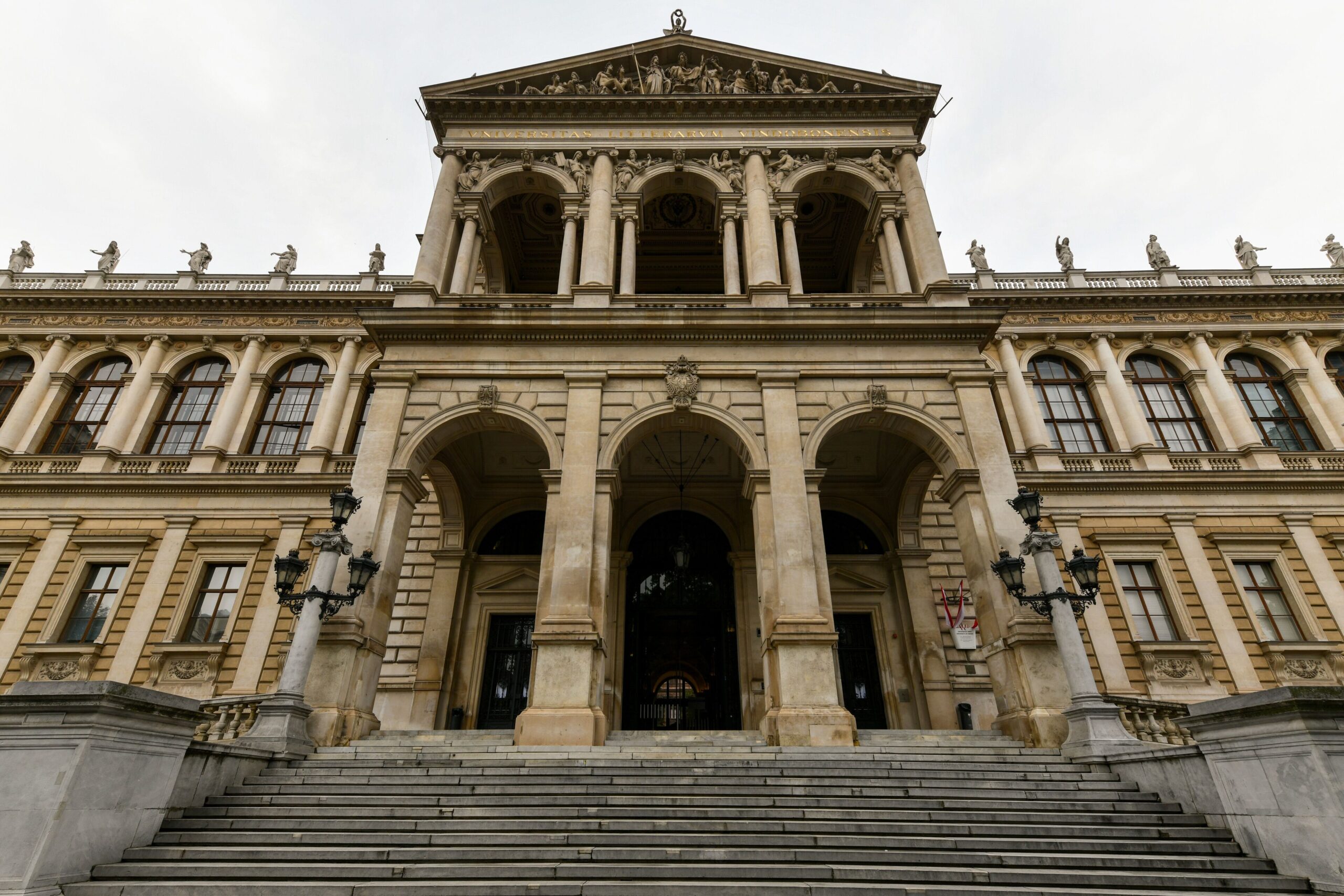
Subsequent to the violent revolutions of the late 1840s in many areas within the vast Habsburg Empire and after catastrophic military setbacks, the brutal Metternich-System collapsed and the young mostly untested Emperor Franz Joseph I (1830-1916) was forced to pass a somewhat enlightened liberal constitution for most parts of the ethnically diverse monarchy. Politically restrained, the “Polizeistaat” was slowly yet hesitantly being replaced by the “Kulturstaat”. Uniform legal rules, equality before the law, the partially ending of censorship, and the liberalization of economic activities among other measures were to provide the keys for the developments of a modern state. Due to this fundamental new freedom, Vienna was about to slowly mature from its elegant imperial splendor with little intellectual stimuli to a culturally vibrating world-center.
Eminent minds from the Empire’s provinces started to flock into Vienna and began to convert the academic institutions into intellectual hotbeds for pathbreaking ideas in almost all academic disciplines. By the end of the 19th century countless important schools, circles or movements developed in fin-de-siecle Vienna: from the famous Vienna schools of Medicine, of Law, of Art, of Economics, to Sigmund Freud’s psychoanalysis, Schoenberg’s new music, Klimt’s and Schiele’s art or the philosophy of Wittgenstein, to the powerful and eadical Austro-Marxist movement under the leadership of Otto Bauer who was not only a student of Eugen von Boehm-Bawerk (1851-1914), but also a friend and colleague of Ludwig von Mises (1881-1973).
III
Among the three scholars who accomplished the strong renewal of a theoretical interest in the social sciences during the 1870s, the Austrian Carl Menger (1840-1921) was in a favorable position. While Leon Walras of Lausanne had been able to address only a small selected group of like-minded people due to his exceedingly complex mathematical expositions, the work produced in London by William Stanley Jevons was essentially received with passive indifference.
Without much external stimulation, or as J. A. Schumpeter put it, “as if from another world, inexplicable, without a cause” Carl Menger independently and unassisted dislodged established theories and successfully challenged the methodology of the social sciences. Although initially more or less ignored by the academic community, his groundbreaking Grundsätze der Volkswirthschaftslehre (1871) eventually fell on fertile ground and was the “Archimedean point” with which Menger revolutionized classical economics. He paved the way for a train of thought that forever changed the Theory of Value and the methodology of the social sciences. In 1876, only five years after the publication of his first book, Menger was appointed as tutor for Crown Prince Rudolph of Habsburg and the “Methodenstreit” of the 1880s between Gustav von Schmoller’s (1838-1917) so-called “younger German Historical School” and predominately Menger fostered his growing academic reputation. In the course of these heated and often ill-disposed debates, von Schmoller repeatedly ridiculed and belittled the new approach as the “Austrian School of Economics” and thus gave the school a name. As an example of an unintended consequence the label sparked a worldwide interest in Menger’s teachings and the school’s growing influence in Europe, the US and also in Japan was hard to miss.
Although neither Eugen von Boehm-Bawerk (1851-1914) nor his brother-in-law Friedrich von Wieser (1851-1926) were Menger’s direct students, they quickly picked up the essence of the Grundsätze and advanced Menger’s work into a complete theoretical system by contributing pathbreaking insights to Capital-, Interest-, and Value theory. Both were the leading scholars of the fast growing 2nd Generation of the school and Boehm-Bawerk’s famous seminar at the University of Vienna (attended by among others Mises, Schumpeter or Strigl but also by the militant Marxists Bauer or Bukharin)as well as his service as Finance Minister in three different cabinets (1895, 1897-1898, 1900-1904) of Imperial Austria played the decisive role in this development. Mention should be made here that aside from his seminal contributions to Capital-, Interest- and Value Theory, Boehm-Bawerk’s “Zum Abschluss des Marxschen Systems” (1896) to date is the most devastating critique of Marx’s economic theories. In this essay, Boehm-Bawerk skillfully reveals the fundamental contradictions and errors at the heart of Karl Marx’s Labor Theory of Value and Surplus Value.
In the decades before the outbreak of WW I, both and scholars such as Eugen von Philippovich (1858-1917) or Robert Zuckerkandl (1856-1926), Robert Meyer (1855-1914), Emil Sax (1845-1927) or Johann von Komorzynski (1843-1914) and others were active at various universities but also in the government of the fin-de-siecle Austro-Hungarian Empire. They all contributed to the emergence of the prolific 3rd generation emerged in Vienna comprising of Ludwig von Mises (1881-1973), J.A. Schumpeter (1883-1950), Alfred Amonn (1889-1953) or Richard von Strigl (1891-1942) among others. The 4th generation included Friedrich A. von Hayek (1899-1992), Gottfried von Haberler (1900-1995), Fritz Machlup (1902-1982), Oskar Morgenstern (1904-1979), Steffy Browne (1898-1992) or Felix Kaufmann (1898-1951) and many others.
The school’s individualistic and subjective methodology, its regard of economics as having a closer affinity with psychology than with mathematics, and the striking distaste for elegant but mostly useless models increasingly gained ground. Soon Austrian Economics was not a field within economics anymore but a challenging alternative for looking at the entire domain of the social sciences. With seminal contributions to monetary-, business cycle-, and international trade theory and groundbreaking advances in the economic calculations and public policy debates, the worldwide academic dominance of the Austrian school lasted well into the 1930s.
During the 1920s and early 1930s, mostly due to the politically volatile times, a despicable racist bias and with not much hope for any decent academic position, Austrian Economics was largely cultivated and taught outside of universities, primarily at the renowned private seminar conducted by Ludwig von Mises. In the wake of the Nazi terror of the 1930s, the vast majority of the 3rd and the 4th generation had to leave Vienna for Switzerland, England, or the USA. Several have tragically perished during the Nazi regime, a few committed suicides, and some took whatever inferior jobs there were or even collaborated with the new political system. And when in 1938 Hans Mayer, editor-in-chief of the “Zeitschrift für Nationalökonomie” and one of Wieser’s brilliant students faithfully endorsed Hitler’s “Anschluss” of Austria, the school also lost its most important publication and Vienna ceased to be the center of Austrian Economics, of its teaching and research. With Mises, Haberler or Lene Lieser in Geneva until 1940, Hayek and Rosenstein-Rodan in London, Machlup in Buffalo (NY) or in New York and Morgenstern at Princeton, the school however continued to exist and further developed in the respective host countries. Hayek’s several daring attempts to revive the Austrian tradition in Vienna in the years immediately following WWII regretfully failed, mostly due to the political situation and administrative constraints imposed by the occupation forces. And yet, despite the difficult times during WWII in Europe and elsewhere, soon a 5th generation grew up. However mention must be made that most of the members of this rising generation emerged from very different educational backgrounds, they also were accustomed to another academic tradition. It is for these reasons that brilliant scholars like Arthur Seldon (1916-2005), Ludwig M. Lachmann (1906-1990) or ), Murray N. Rothbard (1926-1995), Hans Sennholz (1922-2007 or Israel M. Kirzner (1930*) thus often developed a diverging methodological approach. The catastrophic Brain Drain from Austria turned into a Brain Gain primarily for the US, the UK and also for Argentina, Peru or Switzerland.
Mostly due to the apparent short comings of applied Keynesianism and the preference of mainstream economics for elegant but useless econometric models, the 6th generation is widely dispersed and teaching at a number of universities in the USA, in South America, the US, South Africa, but also at European academic institutions, foremost in the Principality of Liechtenstein, at LUISS in Rome, FMU in Guatemala, ESEADE and Rosario in Argentina, at the University of Aix-Marseille, Universidad Rey Juan Carlos in Madrid, the Universities of Hamburg, of Zurich or Prague, … . Its members are among many others Vernon L. Smith (Nobel Prize 2002), Lawrence White, George Selgin, Peter J. Boettke, Mario Rizzo, Richard Ebeling or the author of these lines in the USA, Raffaele de Mucci, Lorenzo Infantino, Alberto Mingardi or Raimondo Cubeddu in Italy, Pedro Schwarz, Philipp Bagus or J. Huerta de Soto in Spain, Pierre Centi, Pierre Garello in France, Hardy Bouillon, Barbara Dluhosch, Christoph Watrin or Heike Walterscheidt in Germany, Martin Krause, Adrian Ravier, or Alberto Benegas Lynch in Argentina, Federico Salazar or Enrique Ghersi in Peru. All of them are engaged in nursing along a very promising 7th generation of Austrians and are currently experiencing an increasing arrival of academic talents.
The philosophy of Austrian Economics is firmly grounded in the theory of subjective value and individual freedom, it underscores the dynamics of free markets, the institution of private property and the Rule of Law. It also stands in explicit opposition to any method that justifies state interventions that are neither compatible with free markets nor with the social fabric of a free society. Its scientific approach is characterized by methodological individualism and Subjectivism, by the Theory of Subjective Value, by the Principles of Marginal Utility and Opportunity Cost, by individual Tastes, Needs and Preferences, and finally by Competion as Discovery Procedure (Hayek) and the Time Structure of Production and Consumption.
In other words, Austrian Economics is not a field within economics anymore but a challenging alternative for looking at the entire domain of the social sciences. Its individualistic and subjective methodology, its regard of economics as having a closer affinity with psychology than with mathematics or physics, and the striking distaste for elegant but mostly vain econometric models is increasingly gaining ground.

Our Partners