1. What is productivity according to the Austrian School of Economics?
The Austrian School of Economics views productivity as the successful alignment of subjective consumer demands with efficient, time-structured production. It rejects aggregate statistical averages, emphasizing instead that true productivity arises from entrepreneurial innovation, capital investment, and time preference (the decision to save rather than consume).
Core Concepts of Austrian Productivity
- Subjective Value: Value and utility are not objective metrics calculated in a lab; they are determined by individual consumers. A productive endeavour is only successful if it satisfies individual desires.
- Time Structure of Production: Austrian capital theory (pioneered by Eugen von Böhm-Bawerk) views production as a sequence of stages spanning time. An economy becomes more productive not just by working harder, but by utilizing ‘higher-order’ capital goods—meaning processes take longer but yield greater output per worker.
- Capital Maintenance: Capital isn’t a homogeneous lump. Creating the wrong kind of capital goods (e.g., building luxury condos instead of necessary infrastructure) results in economic waste, a concept heavily detailed in Austrian Capital-Based Macroeconomics.
Entrepreneurship and Market Efficiency
The Austrian School posits that entrepreneurs are the driving force behind productivity. In an ever-changing market, entrepreneurs adjust the combination of capital and labour to fix price discrepancies, uncover profitable ventures, and minimize economic waste. True efficiency is not achieving some mathematical equilibrium but effectively utilizing the means at an individual’s disposal to reach subjectively determined goals.
Scepticism Toward Aggregate Statistics
Austrian economists are notoriously sceptical of aggregated productivity statistics (such as GDP per capita). They argue that:
- Adding up diverse, subjective economic activities distorts the reality of specific localized conditions.
- Shifts in consumer demand can incorrectly skew aggregate productivity numbers.
- Artificial manipulation of interest rates and money supply distorts the structure of production, leading to unsustainable booms and busts that disguise true productivity.
The Role of Savings and Time Preference
Productivity growth fundamentally hinges on the savings rate. When individuals exhibit a lower time preference (valuing the future over the present), they save more money. These savings are then funnelled into investment in capital goods, which amplifies output.
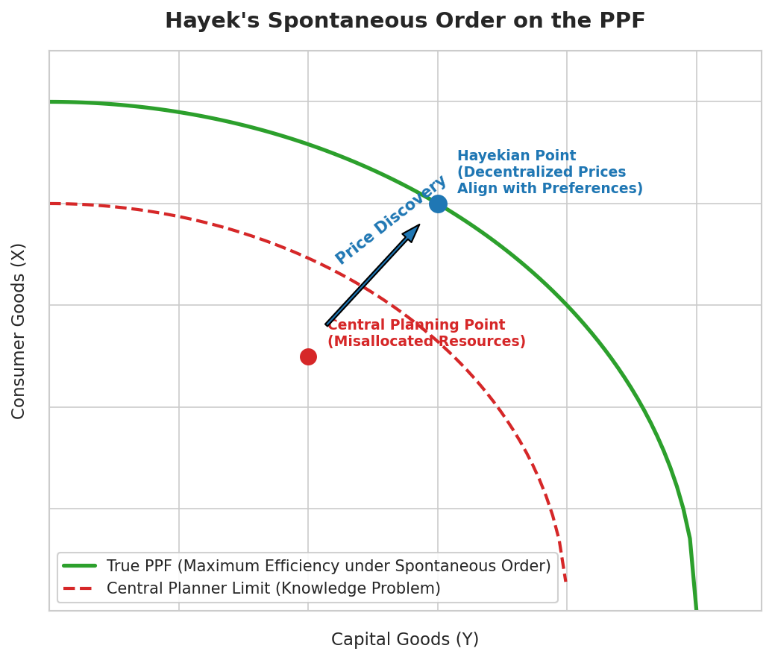
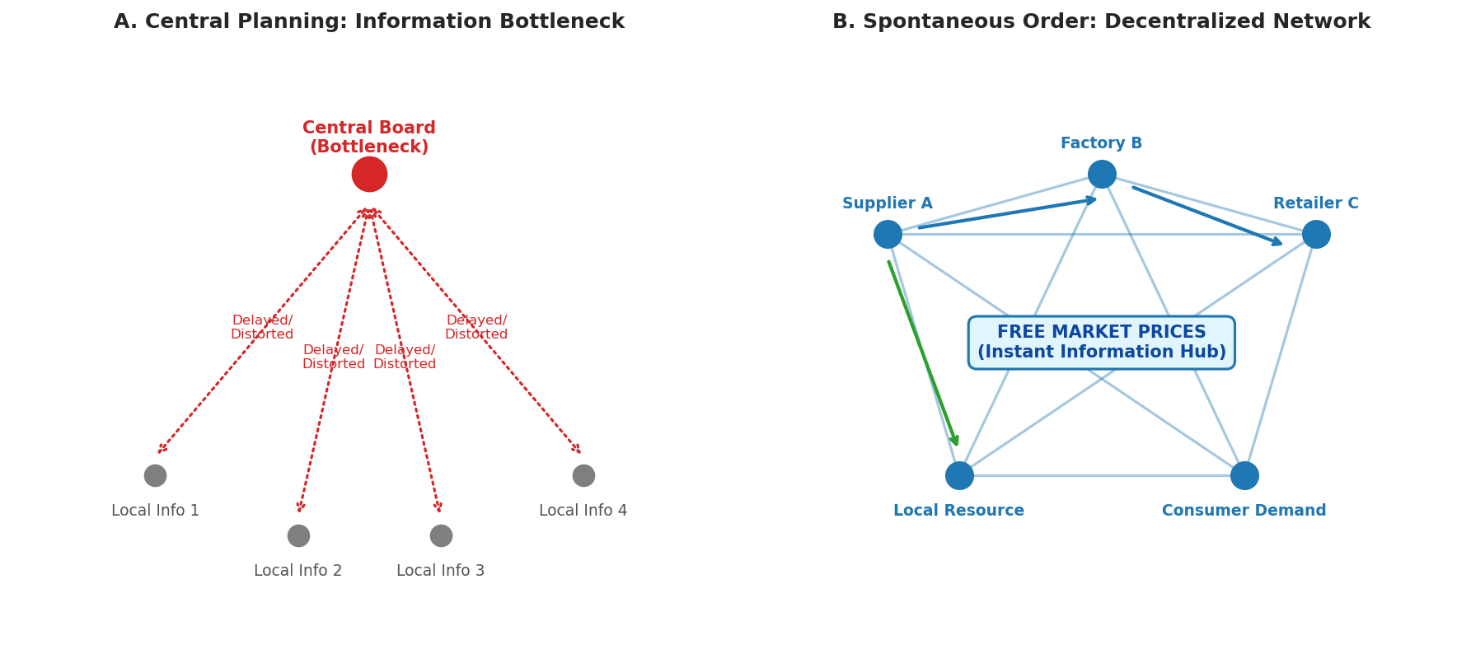
Friedrich A. von Hayek provided a precise framework for understanding why Total Factor Productivity (TFP) differs radically across economies and economic systems. In one of his most famous works, The Use of Knowledge in Society (1945), Hayek argued that the essential economic problem for policymakers to solve was not how to allocate resources (the task traditionally entrusted to central planning), but how to best utilize dispersed information that is not fully known to anyone.
Thanks to the market mechanism, prices, according to Hayek, act as an extraordinary, decentralized communication and signalling network, through which the dispersed knowledge and preferences of millions of individuals can be instantaneously transmitted.