
When the populist leaves, the policies stay
Elections are supposed to change things. And in one sense, they do: when a populist government loses power, the rhetoric changes almost overnight. The speeches shift in tone, the enemy-of-the-people framing disappears, and international observers breathe a collective sigh of relief. But rhetoric is not policy. And policy, it turns out, is far stickier than the governments that created it.
This pattern has consequences for how we evaluate political transitions, assess reform prospects, and understand why economic recovery in post-populist countries is almost always slower and harder than it looks from the outside.
Measuring populism beyond the rhetoric
Rhetoric captures the degree to which a governing party uses populist language — anti-elitism, people-centrism, us-versus-them framing. Economic populism captures the concrete policy environment: business and labor market regulations, government interference in the economy, monetary and financial freedom, and trade openness. Institutional populism captures the health of democratic institutions: rule of law, judicial and legislative constraints on the executive, corruption, freedom of expression, and property rights. Each component moves independently. A government can have high rhetoric and moderate policy. A successor government can inherit high policy scores with virtually no rhetoric at all.
That last scenario is not hypothetical. It is what the data shows when populist governments leave office.
Argentina: The Kirchnerist legacy under Macri
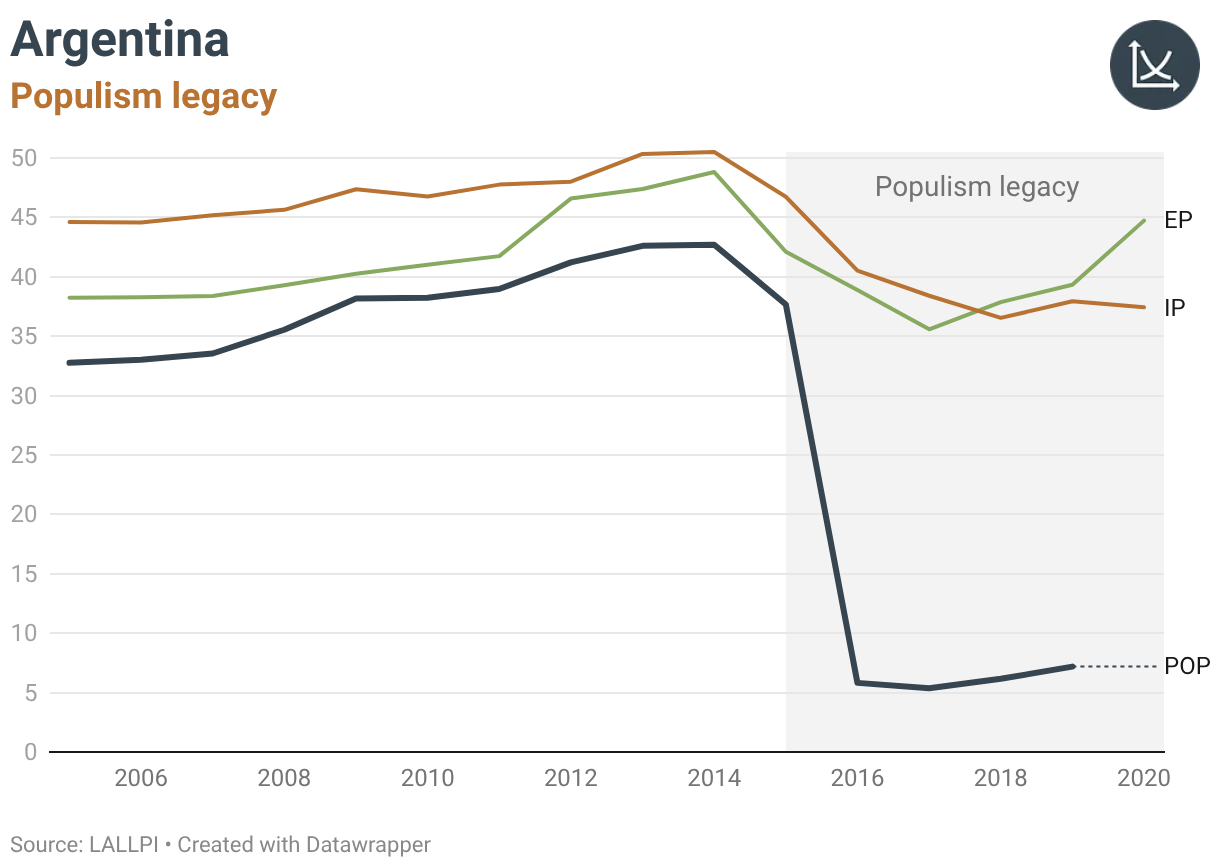
Macri’s election represented an unambiguous rhetorical break. Cambiemos was a centrist, market-oriented coalition that campaigned explicitly on institutional normalization and economic reform. POP_R falls sharply at the 2015 transition — exactly what one would expect. What does not fall, at least not immediately or substantially, is the policy environment. Energy subsidies could not simply be eliminated without a phased adjustment that still generated significant political conflict. The central bank had been hollowed out institutionally and could not recover its credibility by decree. The regulatory apparatus built over twelve years of Kirchnerism remained in place. Property rights and judicial independence do not automatically strengthen when a new government stops attacking them — the damage is structural, and reconstruction is slow.
By 2018, the last year of available LALLPI data, Argentina’s EP and IP components remain elevated relative to the pre-Kirchner baseline, even as POP_R sits at levels reflecting a non-populist governing coalition. The chart tells the story in a single image: rhetoric and policy diverge at the transition and do not converge within Macri’s term.
Ecuador: When the successor comes from within
If Argentina’s case is compelling, Ecuador’s is even more striking — because the rhetorical shift there cannot be attributed to ideological opposition winning an election. When Lenín Moreno succeeded Rafael Correa in May 2017, he did so as Correa’s chosen successor, running on the same political platform that had governed Ecuador for a decade. And yet within months of taking office, Moreno began distancing himself from Correa’s style, abandoning the confrontational anti-elite rhetoric that had defined Correísmo, and eventually breaking with his predecessor entirely.
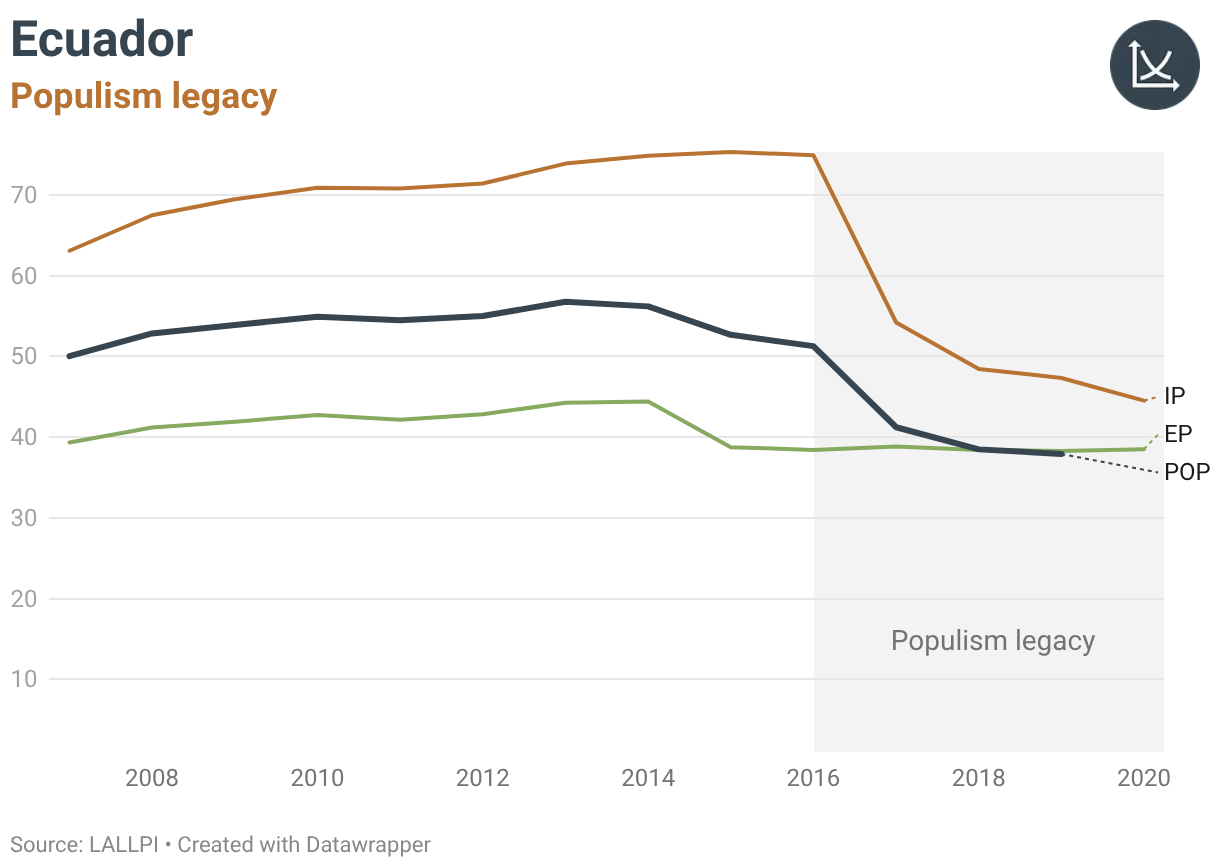
The rhetorical shift is visible in the data. POP_R declines at the 2017 transition in a way that reflects Moreno’s genuine repositioning. What the LALLPI data reveals next is more nuanced — and more instructive. Ecuador’s institutional populism index (IP) shows a meaningful recovery after 2017, even though Correa’s rewritten constitution remained formally in place. The institutional damage, it turns out, was more elastic than it appeared: once the political pressure driving it was removed, judicial behavior, constraints on the executive, and related indicators began to recover. Formal constitutional changes are sticky by design, but the informal norms and practices that animate those institutions responded to the change in political environment more quickly than one might expect.
The economic legacy is another story. Ecuador’s EP component remains elevated after the transition, and here the public choice logic bites hard. Correa’s decade had created dense economic constituencies: state enterprise employees, subsidy beneficiaries, and regulated industries that had reorganized their operations around the existing framework. Reversing those arrangements meant concentrating immediate losses on organized groups while spreading the gains of reform diffusely across the economy over the long run — a politically losing trade that even a willing reformer finds difficult to execute. Moreno inherited not just the policies but the incentive structure that made them durable. The rhetorical break was clean; the economic break was not.
Why policies outlast the governments that made them
The economic dimension is the most familiar — and, as the Ecuador case suggests, potentially the most durable. Subsidies, price controls, trade restrictions, and state ownership all generate beneficiaries who become organized constituencies for maintaining those policies. The costs of reversal are immediate and concentrated — specific groups lose specific benefits — while the gains are diffuse and long-run. No political coalition has strong incentives to absorb those concentrated losses on behalf of benefits that accrue broadly and gradually. This asymmetry does not require bad faith on the part of successor governments. It is simply the political economy of reform, and it operates regardless of who wins the election.
The institutional dimension is less straightforward. The conventional wisdom holds that institutional damage is the harder problem — that weakened courts, compromised regulatory agencies, and eroded norms of executive constraint outlast everything else. Ecuador complicates that story. Despite Correa’s decade-long effort to redesign the constitutional architecture of the state, the institutional populism index shows meaningful recovery after Moreno’s transition. Once the political pressure driving institutional erosion was removed, judicial behavior and executive constraints began to normalize — even with the formal constitutional changes still on the books. Informal norms, it turns out, can be more elastic than formal rules in both directions: they deteriorate under sustained political assault, but they can also recover when that assault stops.
What this suggests is that the two components of populist legacy do not move in lockstep. Rhetoric falls first and fastest. Institutional damage can recover with political will. Economic entrenchment — the web of subsidies, regulations, and state structures that creates organized constituencies — is the last to yield, and often outlasts both.
What this means for reform — and for how we watch Latin America
This matters for how investors assess country risk, how international institutions design conditionality, and how citizens in post-populist countries calibrate their expectations. Reform takes longer than electoral cycles. Institutional recovery is measured in decades, not terms. The governments that succeed populists inherit not just the policies but the political economy surrounding them — the constituencies, the distorted incentives, the damaged institutions — and navigating that inheritance is often the central challenge of their tenure.
Bolivia and Nicaragua present potentially even starker cases of policy entrenchment, but the current LALLPI data window does not extend far enough past their respective political transitions to support the same analysis. That is a limitation worth acknowledging — and a direction for future work as the index is extended.
For now, the Argentina and Ecuador data make the core pattern visible. Populist governments end. Their legacy, measured in the economic and institutional terrain they leave behind, does not.



Our Partners