
Staple food prices surge as conflicts spread
The world is entering a period in which food is no longer merely a component of consumer-price indices but a potential source of geopolitical fragmentation and financial instability. In the summer of 2026, prices for wheat, rice and soybeans – three staples that anchor diets – peaked near 2022 highs. By mid-November, prices for wheat had pulled back slightly but remained about 15 percent higher year-on-year, while soybeans were up almost 10 percent and rice had soared 75 percent.
These increases have distinct agricultural and market-specific causes, but they share a dangerous common architecture: conflict-related trade disruption, high energy and fertilizer costs and the growing likelihood that exporting governments will restrict sales abroad in order to protect domestic consumers.
Wheat: Middle East and Africa exposed to Black Sea disruptions
Wheat is the clearest example of a staple whose price is driven by the intersection of war and geographic bottlenecks. The crop is widely grown in both Russia and Ukraine, and war there continues to affect Black Sea shipping, insurance, port access and export logistics.
Even when grain shipments are feasible, the cost and uncertainty of moving it can make export quotations volatile. The Food and Agriculture Organization (FAO) noted recently that Ukrainian wheat export quotations have been affected by ongoing logistical constraints, while increasingly common Black Sea drone attacks on commercial ships are restricting trade flows and reducing the reliability of alternative transport capacity.
The regional consequences are concentrated but global in effect. Turkiye, North Africa, the Middle East and parts of sub-Saharan Africa rely heavily on imported wheat and are particularly exposed to Black Sea disruptions.
A prolonged interruption does not merely raise the price of bread; it raises the fiscal cost of food subsidies, increases demand for foreign exchange and can worsen balance-of-payments pressure in import-dependent states.
The 2022 grain-price shock, which resulted from Moscow’s invasion of Ukraine, demonstrated that wheat markets are politically combustible: Food-price inflation can contribute to unrest, especially where bread subsidies are already strained.
Climate stress compounds the conflict effect. FAO reporting points to hot and dry weather reducing production prospects in parts of Europe, while dry conditions in North America have affected sowing expectations and crop conditions.
When, simultaneously, Black Sea shipping is disrupted, North American weather deteriorates and European yields fall, the market loses the buffers that normally prevent local shocks from going global.
Rice: Asia’s vulnerability and India’s export policy
Rice is different from wheat in its market structure, and potentially more dangerous in its political consequences. More than half the world’s population depends on the cereal grain as a staple, and production is concentrated in Asia.
The increase in rice prices in 2026 reflects both weather and policy. India is the world’s largest rice exporter; its prohibition of certain rice exports in July 2023 amplified the upward price pressures already created by seasonally tighter supplies and strong Asian purchases. In November 2026, New Delhi was likely to reimpose export controls on rice.
FACTBOX: Leading global rice exporters
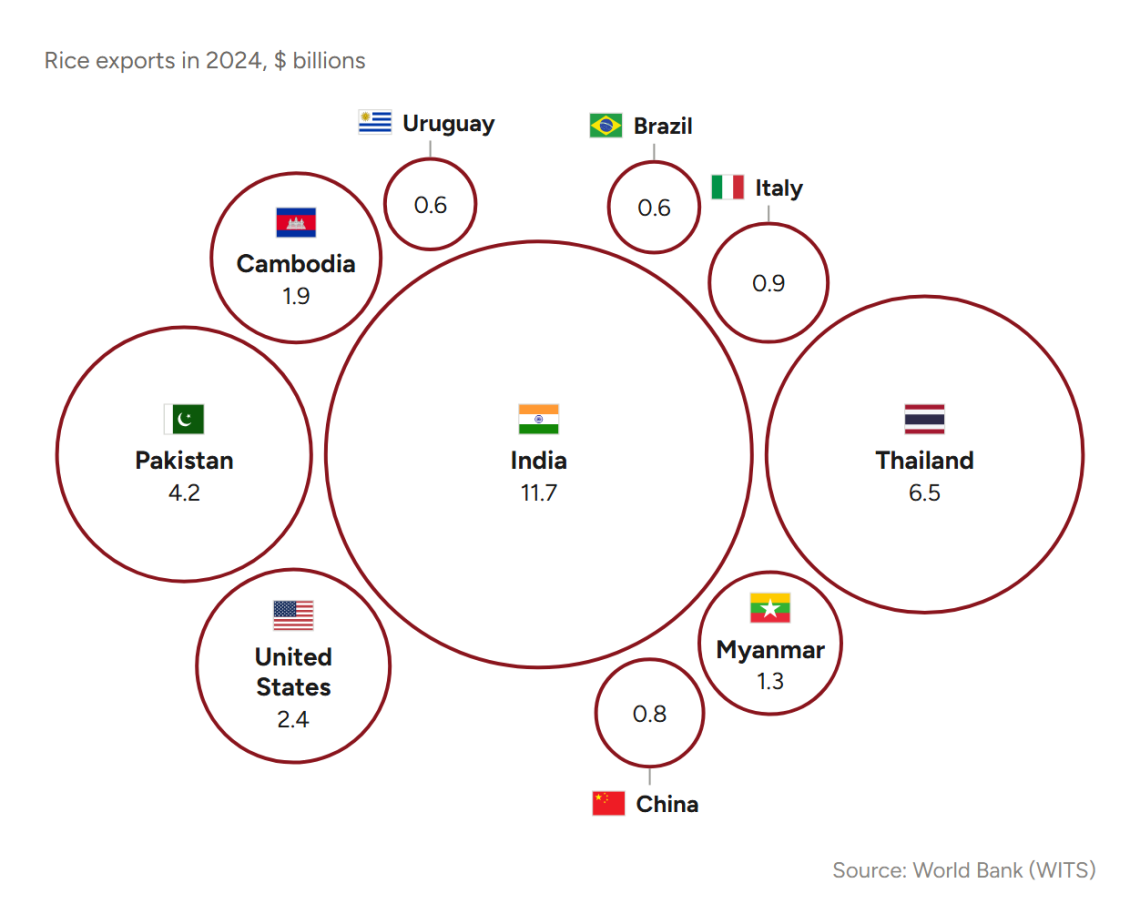
India is not acting irrationally. With a large domestic population and a political imperative to contain food inflation, export controls are a familiar instrument of food-security management. But when New Delhi restricts shipments, the effect is immediate for Bangladesh, Indonesia, the Philippines, parts of Africa and other import-reliant markets.
Rice also illustrates the “protectionism in reverse” dynamic. Traditional protectionism shields domestic producers from foreign competition. Defensive food protectionism shields domestic consumers from global scarcity by keeping food at home. Such policies reduce the global pool of tradable supply, and make importing countries pay more for a smaller available volume. Because only a small share of the world’s rice is traded across borders, export curbs remove a relatively large share of what importers can buy.
FACTBOX: Global rice production
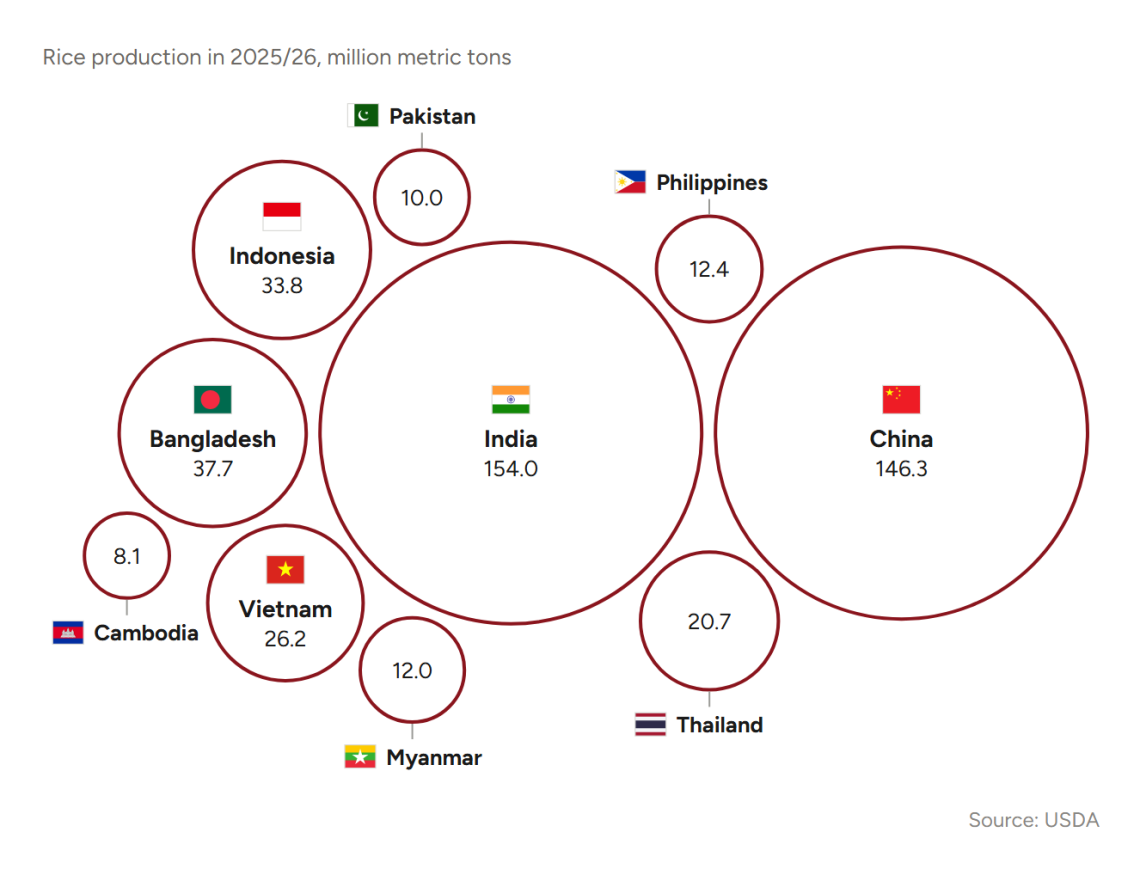
The risk is that trade disruptions for rice spark a food-commodity cascade. Higher rice prices push consumers toward wheat, maize, cassava or other staples; those substitutes then face increased demand, and governments in producing countries respond with further restrictions. Food inflation spreads across the staple complex even where the original shock was localized.
Soybeans: Feed, oil and China
Soybeans occupy a different position in the food system. They are not primarily a direct human staple in the way wheat and rice are, but they are indispensable to edible-oil markets, animal feed and industrial food production.
The soybean market is also highly sensitive to China. The country’s import demand influences global flows; stronger Chinese purchases can draw down stocks even when global supply is broadly adequate. This creates a channel through which Chinese economic policy, currency movements, port logistics and bilateral trade tensions can affect food prices far beyond Asia.
Climate risk is equally relevant. Soybean production is concentrated in Brazil, the United States and Argentina, regions now exposed to excessive rainfall, heat and shifting growing seasons. Any simultaneous disruption in South and North America would tighten meal and oil supplies just as livestock producers face higher energy and feed costs.
The U.S.-Iran war and the cost of growing food
Agriculture is an energy-intensive industry. The Iran war has added another layer of risk because it affects energy markets and fertilizer input costs. Urea prices rose roughly 40 percent in the early phase of the crisis, a development with direct implications for future yields even if grain prices did not immediately rise in proportion.
This is the crucial lag in the system. Energy shocks can raise today’s food prices while reducing tomorrow’s harvests. If farmers apply less urea, delay planting, reduce irrigated area or shift away from fertilizer-intensive crops, the supply response arrives months later.
Export restrictions: Protectionism in reverse
The most consequential policy risk is a wave of export restrictions. India’s rice export restrictions over the years are a recurring example. Wheat-export controls have also been used in past periods of stress, including India’s 2022 ban, which was justified by domestic food-security concerns. If wheat prices remain elevated, other exporters may face similar domestic pressure and prioritize domestic stability when global prices surge.
The economic consequence of these trade complications is a fragmentation of food markets. Instead of allowing price signals to allocate scarce supplies efficiently, export restrictions ration access by political proximity, bilateral relationships and purchasing power. Large, creditworthy importers may secure supplies through long-term contracts, leaving smaller states to bid for residual volumes at higher prices. This is food security pursued nationally at the expense of food security globally.
The distributional effect is severe. Import-dependent countries in the Middle East, North Africa, the Sahel, Central America and parts of Asia face the sharpest squeeze. They must pay more for food, spend more scarce foreign exchange reserves and potentially borrow more to finance subsidies.
From food inflation to financial stress
Food-price inflation does not remain confined to agricultural markets. It feeds into headline inflation, influences central-bank policy, raises bond yields and increases the cost of refinancing both sovereign and corporate debt. This is where the agricultural crisis connects to the wider financial system.
Global public debt is nearing the highest-ever levels reached during the Covid-19 pandemic and is projected to approach or exceed 100 percent of global gross domestic product (GDP); the International Monetary Fund has estimated U.S. gross debt reaching 142.1 percent of GDP by 2031.
Higher food prices force governments to choose between subsidizing consumers, supporting farmers, funding strategic reserves and maintaining fiscal credibility. If they do all four simultaneously, deficits widen; if they do none, social and political pressure rises.
Private credit adds a further vulnerability. In 2026 alone, companies have raised an estimated $850 billion in debt for artificial intelligence-related expenditure, much of it tied to data centers, power infrastructure, chips and related supply chains. The trend is set to continue, reaching trillions of dollars and resulting in less money readily available for sovereign borrowers.
Recent market reporting highlights concerns that private credit could be the next area of stress. This does not make food the direct cause of an AI-credit crisis, but it illustrates systemic interdependence: A food-price shock that raises inflation and long-term yields would increase debt-service costs across the economy.
A crisis of interdependence
The ongoing staple-food price surge should therefore be viewed as a systemic-risk event rather than a sectoral commodity story.
Wheat links the Black Sea to North Africa; rice ties Asian monsoons to African and Middle Eastern food baskets; soybeans connect South American weather to Chinese demand and global livestock production. Energy links all three to fertilizer, diesel, freight and insurance. Government bonds connect all of these to fiscal capacity, while private credit binds them to the broader financial cycle.
The main policy danger is that governments respond nationally to a globally interconnected problem. Export bans, stockpiling, bilateral grain deals and price controls may buy time domestically, but they can turn a supply disruption into a trade fragmentation shock.
Under such circumstances, the world risks a food-price spiral in which every state attempts to secure its own supply, global markets become thinner and more volatile, and the countries least responsible for the shock suffer most.
Food is the point at which war, energy markets, climate stress, trade policy and sovereign finance converge. The surge in wheat, rice and soybeans is therefore not only a warning about agriculture, but also a reminder of the interconnected nature of the economic order.
Scenarios
Most likely: Prolonged food-affordability crisis without a supply collapse
The most likely case is a serious food-security and fiscal shock, but not yet a systemic global famine or financial crisis.
Food prices remain elevated through late 2026 and into 2027 as Black Sea shipping constraints, energy shipment disruptions in the Strait of Hormuz, and higher fertilizer and energy costs keep markets tight. Even so, global cereal stocks and production remain broadly sufficient. The FAO still forecasts a stocks-to-use ratio into 2027 of 31.7 percent and a near-record cereal harvest.
The pressure therefore passes mainly through retail prices, import bills and subsidy costs rather than physical shortages. Net food-importing countries in Africa, parts of Asia and small island states are hit first, with consumer food inflation becoming visible from the end of 2026 after a three-to-six-month transmission lag.
Governments respond with targeted subsidies, strategic-stock releases and selective export controls, while humanitarian needs deepen in Eastern and Southern Africa and conflict-affected Sudan, Somalia and South Sudan.
Less likely: Cascade of export restrictions and regional supply shortages
A deepening El Niño has already begun to damage rice crops in South and Southeast Asia while dry weather is further weakening North American wheat and South American soybean conditions. As a result, in this scenario, major exporters – particularly Argentina, Brazil, India, Russia, Thailand or Vietnam – impose export quotas, taxes or bans to protect domestic consumers.
Because internationally traded volumes are small relative to production, these measures sharply reduce available global supply and trigger panic buying, higher freight and insurance costs, and further restrictions by other exporters.
Wheat and rice shortages become more than an affordability problem in import-dependent states, while soybean-meal costs raise meat, dairy and egg prices globally. Food inflation then feeds into headline inflation, forcing tighter monetary policy just as governments need fiscal space for food subsidies.
In response, long-dated borrowing costs rise further, worsening debt-service pressures in vulnerable sovereigns. This scenario is less likely because current stocks provide a buffer, but it becomes materially more probable if export restrictions spread or the Strait of Hormuz disruption persists.
Least likely: Global food emergency with financial contagion
Several shocks coincide: A sustained closure or severe disruption of Hormuz, the renewed interruption of Black Sea grain exports, simultaneous El Niño-driven crop failures across Asia and the Americas and broad export bans on grain, edible oils or fertilizer.
Physical shortages would emerge in import-reliant regions, food-price inflation would accelerate worldwide and governments would compete for scarce cargoes through bilateral deals and stockpiling.
The financial channel would then intensify: Higher inflation and sovereign yields reduce fiscal capacity, while stressed food-importing states face currency pressure and refinancing risk. Private credit and highly leveraged AI-linked borrowers would face higher funding costs, though food would be a macro-amplifier rather than the sole trigger.
This perfect-storm outcome remains least likely because global food stocks, diversified harvest regions and policy tools still offer protection – but it is no longer implausible if climate, conflict and trade fragmentation reinforce one another.



Our Partners