
How protectionism is breaking the North American alliance
How North America’s trade peace broke down
That era of steadily expanding integration began to break down during Donald Trump’s first presidency. In 2018, Washington imposed 25% tariffs on Canadian steel and 10% on aluminum, triggering retaliation from Ottawa. The dispute eased after the tariffs were lifted in 2019, and the USMCA seemed to put the relationship back on a more stable footing. That stability proved temporary. After returning to office in 2025, Trump again turned to tariffs, imposing new duties on Canadian imports and setting off a new round of trade tensions.
That strategy soon ran into a legal obstacle. In February 2026, the Supreme Court ruled that the emergency-powers law Trump had relied on did not authorize those tariffs. But the ruling did not end the administration’s protectionist push. Instead, it turned to other trade laws, including the little-used Section 338 of the Tariff Act of 1930, to continue its tariff campaign against Canada.
The historical symbolism is hard to miss. Section 338 of the Tariff Act of 1930 is tied to the Smoot-Hawley tariffs, one of the most infamous protectionist experiments in American history, which helped trigger foreign retaliation and deepen the economic downturn during the Great Depression, when US trade fell by roughly two-thirds between 1929 and 1932. The provision allows tariffs of up to 50% on countries deemed to discriminate against American commerce, yet it had never been invoked until Trump used it against Canada in July 2026.
Even then, a negotiated settlement briefly appeared possible, with progress on metals and discussions over reviving the Keystone XL pipeline. But talks broke down over automobiles, steel, agriculture, digital trade, Canadian cultural policies, and, more fundamentally, over Washington’s effort to restrict Canada’s ability to pursue future trade agreements and diversify beyond the US market.
After negotiations failed, the 50% tariffs Washington had announced in July took effect on roughly $20 billion in Canadian goods, prompting Canada to retaliate against a similar value of US imports. Trump has since threatened to extend 50% tariffs on Canadian cars, trucks and auto parts beginning January 1, 2027. Ottawa, meanwhile, has strategically targeted politically sensitive US exports—including dairy, seafood and farm equipment—to concentrate the economic pain in electorally important states and increase political pressure ahead of the midterm elections.
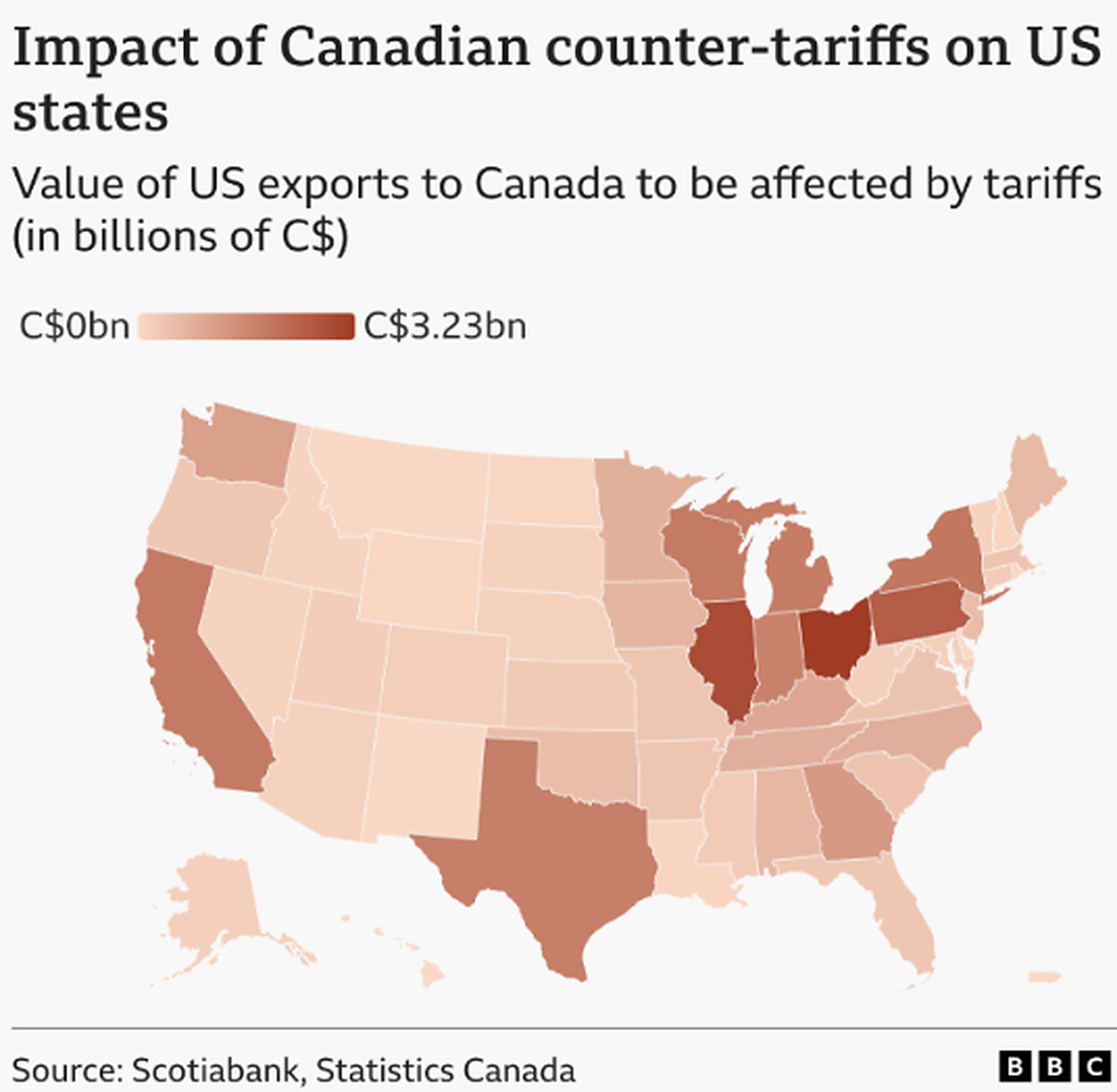
What began as a tariff dispute has thus become a cycle of escalation and retaliation, with economic costs on both sides of the border.
Why tariffs hurt both sides of the border
Canada enters the confrontation from the weaker position. Its economy is roughly one-tenth the size of America’s, and the US remains its largest export market. Canada lost 55,000 manufacturing jobs between January 2025 and January 2026, while the latest tariffs could reduce its GDP growth by around 0.3% next year and put an estimated 100,000 to 130,000 jobs at risk.
Small businesses are especially vulnerable. In one Canadian Federation of Independent Business survey, 40% of exporters reported selling products affected by the new tariffs. Nearly 80% expected revenue losses, and more than a third anticipated losses of at least 50%. But Canada suffering more does not mean America benefits. The relationship is too integrated for that.
Consider automobiles. A vehicle assembled in Canada may contain parts that cross the border several times before reaching a dealership. More than half the value of Canadian vehicle exports to the US comes from American parts, connecting workers on both sides of the border. With Canadian aluminum entering US factories and American steel moving north for processing, tariffs do not simply punish Canada—they raise production costs across North America.
American vulnerability extends beyond manufacturing. In 2025, Canada supplied about 63% of U.S. oil imports, 81% of imported electricity, nearly all imported natural gas, and 80% of imported potash, a crucial fertilizer input. Ottawa could use that dependence as leverage, but doing so would also hurt Canadian producers and push US buyers toward alternative suppliers.
Consumers eventually encounter those costs too. The Yale Budget Lab estimates that the broader set of current US tariffs could cost the typical American household roughly $1,077 a year. The newest tariffs specifically targeting Canadian goods represent only a fraction of that burden, but further escalation—especially in automobiles, energy, or critical inputs—could push the cost higher.The dispute also puts the USMCA at risk, threatening an agreement that underpins roughly $1.6 trillion in annual trilateral trade. Its erosion would bring greater uncertainty, higher costs and weaker investment across North America. Canada may suffer more, but Americans will also pay through higher prices, weaker exports and disrupted supply chains. The consequences now extend beyond bilateral trade. In September, Prime Minister Mark Carney welcomed a proposal for Canada to become the EU’s first “associate member,” reflecting Ottawa’s effort to reduce its dependence on the United States. Trump called the proposal potentially hostile and threatened further tariffs, but such pressure may only push Canada closer to Europe. Washington and Ottawa should return to what made North American integration successful: lower barriers, predictable rules and open trade. Turning the border back into a tax wall would make neither country stronger—only poorer.


Our Partners