Germany’s long industrial decline
For decades, Germany was the economic engine of Europe. Its prosperity rested on a highly competitive industrial sector, a strong export orientation and a reputation for engineering excellence. Even as other advanced economies shifted toward services, Germany maintained a large manufacturing base that became central to its economic model.
Today, however, the German economy faces growing challenges. Economic growth has slowed, investment has weakened and concerns about deindustrialization have become increasingly prominent in public debate. While recent attention has focused on the consequences of the Covid-19 pandemic, the energy crisis and geopolitical tensions, Germany’s economic difficulties have deeper roots.
Germany’s current malaise cannot be understood as the result of a single crisis or temporary shock. Rather, it reflects a long-term deterioration in industrial competitiveness. Major crises such as the global financial crisis of 2008 and the Covid pandemic of 2020 acted as turning points, but not because they directly caused Germany’s decline. Instead, each crisis accelerated policy developments that progressively increased costs, weakened incentives for investment and eroded Germany’s standing as an industrial location.
From growth to stagnation to decline
Germany’s economic success has long been closely tied to the performance of its industrial sector. Manufacturing remains more important to the German economy than to most other advanced countries, accounting for a substantial share of exports, investment and productivity growth. It generates close to 21 percent of German gross value added, against a European Union average of about 17 percent – the highest share among the large European economies. Industrial production therefore provides a useful indicator of Germany’s overall economic health.
Since reunification, German industrial production has moved through three distinct phases. From 1991 to 2008 it expanded steadily. Benefiting from globalization, growing export markets and a strong competitive position in high-value manufacturing, German industry added an average of 1.5 points a year to the Eurostat production index (where 2015 = 100).
The global financial crisis marked a turning point. Although industrial production recovered from the sharp contraction of 2008-2009, the pace of growth slowed significantly. Between 2011 and 2019, industrial production increased by only 0.8 index points per year. The crisis itself proved temporary, but the growth trajectory that followed was markedly weaker; Germany’s industrial sector continued to expand, yet it no longer served as a major engine of economic growth. Output in fact peaked in 2017 and was already easing before the pandemic struck.
A second turning point occurred during the Covid pandemic. As in 2008-2009, industrial production initially collapsed before rebounding. Unlike the previous recovery, however, the rebound proved short-lived. Since 2021, industrial production has followed a negative trend, declining by an average of 2.3 index points per year. Germany’s industrial sector is therefore no longer merely stagnating; it is contracting at a rapid pace. In fact, German industrial output is today at the same level as in 2005. Overall, there has been no growth in industrial production over more than two decades.
Facts & figures: Industrial production in Germany since reunification
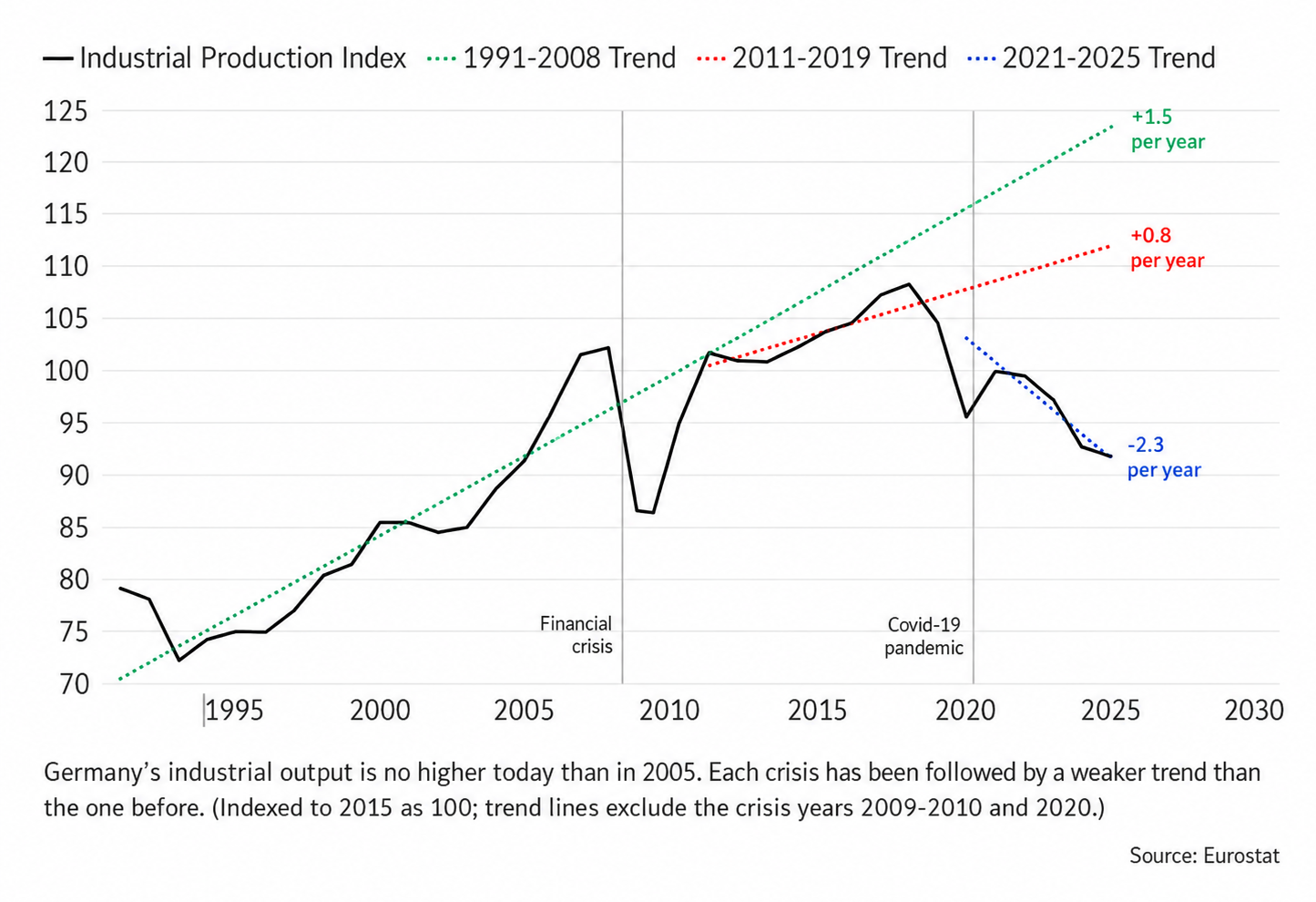
The temporary declines in output matter less than what followed them: After each crisis, the trend resumed at a weaker rate than before. Germany moved from industrial expansion before 2008, to stagnation after the financial crisis and finally to decline after the pandemic. The key question is why Germany repeatedly failed to return to its previous growth path. The answer lies in the policy choices and structural changes that followed.
The erosion of German competitiveness
Germany’s industrial decline did not occur in a vacuum. The financial crisis and the Covid pandemic undoubtedly disrupted production and global supply chains, but they do not explain why each recovery proved weaker than the last. The reason lies in the gradual erosion of Germany’s industrial competitiveness.
One important factor has been energy policy. For decades, German industry benefited from reliable and comparatively affordable energy supplies. This advantage gradually weakened as policymakers pursued the Energiewende, Germany’s ambitious transition to renewable energy sources. While the goal of reducing carbon emissions enjoys broad political support, the transition increased energy costs and created greater uncertainty for energy-intensive industries.
What distinguishes Germany is that domestic policies reduced its ability to adapt.
Nuclear power worsened the problem. Berlin agreed to phase it out in 2000, accelerated the timetable after Fukushima in 2011 (reversing an extension granted months earlier) and shut the last three reactors in April 2023. This further reduced the diversity of Germany’s energy mix while increasing reliance on imported natural gas. When Russian gas supplies were disrupted following Russia’s invasion of Ukraine, these vulnerabilities became impossible to ignore. The resulting energy shock hit precisely those sectors – chemicals, automotive manufacturing and industrial machinery – that form the backbone of Germany’s industrial economy. The energy crisis exposed and amplified weaknesses that had been building for years.
A second factor has been the cumulative impact of regulation and climate policy. Over the past two decades, German policymakers increasingly prioritized environmental and social objectives alongside economic growth. Many of these policies pursued legitimate goals, including emissions reduction, worker protection and sustainability. Yet their cumulative effect was to increase the cost and complexity of doing business. Firms faced rising compliance costs, lengthy permitting procedures, extensive reporting requirements and persistent uncertainty about future regulatory changes.
Environmental regulations and carbon pricing schemes placed additional burdens on industrial sectors already facing intense international competition. While each individual measure may have appeared manageable on its own, together they reduced Germany’s attractiveness as a destination for industrial investment. The result was a gradual decline in competitiveness that was more visible after each economic crisis.
Germany’s difficulties were compounded by changes in the global economy. For many years, German manufacturers benefited from rapid globalization and growing demand from emerging markets, particularly China. More recently, however, China has evolved from a major customer into a powerful competitor. Chinese firms increasingly challenge German producers in automobiles, machinery and advanced manufacturing. German exports of cars and parts to China fell by roughly a third in 2025, to under 14 billion euros – less than half the nearly 30 billion euros recorded in 2022, according to the German Economic Institute. Demographic aging has contributed to labor shortages and constrained productivity growth. These developments have created challenges for all advanced economies; what distinguishes Germany is that domestic policies reduced its ability to adapt to them.
Taken together, these developments help explain the pattern. The financial crisis and the pandemic were not the fundamental causes of Germany’s industrial decline. Rather, both crises accelerated a longer-term deterioration in competitiveness. Rising energy costs, expanding regulatory burdens and a changing global environment progressively weakened Germany’s industrial model. As a result, each recovery proved weaker than the last – turning expansion into stagnation and stagnation into decline.
Scenarios
Most likely: Managed stagnation
The most likely scenario is managed stagnation. In this case, the government implements limited reforms to reduce bureaucracy, accelerate permitting and contain energy costs, but avoids a more fundamental shift in economic policy. Industrial production stabilizes somewhat, but does not return to its pre-2008 growth path.
Large firms continue to invest selectively in Germany, while placing more dynamic projects abroad. The Mittelstand, Germany’s mid-sized and often family-owned manufacturers, remains resilient but increasingly constrained by labor shortages, regulation and weak domestic demand. Germany avoids a dramatic industrial collapse, but gradually loses economic weight. Growth remains weak, fiscal pressures rise and the country becomes less central to Europe’s economic future. The likelihood of this scenario is 50 percent.
Less likely: Accelerating deindustrialization
In the pessimistic scenario, Germany fails to address the structural problems undermining its competitiveness. Energy costs remain high, regulatory burdens continue to grow and investment increasingly flows to more attractive locations abroad. At the same time, competition from China intensifies, particularly in sectors that have traditionally formed the backbone of German industry.
As firms relocate production and postpone investment, industrial output continues to decline. The erosion of the industrial base spreads to employment, tax revenues and innovation capacity. Economic growth remains weak or negative, while social and political tensions increase. Germany loses much of the industrial strength that once made it Europe’s economic engine. The likelihood of this scenario is 30 percent.
Least likely: Industrial renewal
In the industrial renewal scenario, Germany restores its competitiveness through regulatory reform, lower energy costs and a more investment-friendly business environment. Permitting procedures are streamlined, the tax burden on businesses is reduced and policymakers weigh industrial competitiveness more heavily when designing climate and energy policies. Confidence gradually returns, encouraging firms to expand production and invest domestically.
Germany’s strengths – its skilled workforce, technological expertise and strong industrial base – allow it to benefit from new opportunities in advanced manufacturing, automation and energy technology. Industrial production resumes modest growth, restoring Germany’s position as a world-leading industrial economy. The likelihood of this scenario is 20 percent.

Our Partners