
France’s fragile economic future
The French unemployment rate has not fallen below 7 percent since the 1970s. In the second quarter of 2026, it stood at 8.3 percent as the economy contended with low labor productivity growth, an aging population and a low workforce participation rate. Many young professionals, including engineers, are leaving the country for jobs abroad, creating significant brain drain and imposing a fiscal burden: The state spends roughly 1 billion euros a year on their education.
Aside from the rebound after the Covid-19 pandemic, France has faced sluggish growth for years. Gross domestic product (GDP) growth was just 0.8 percent in 2025, and the International Monetary Fund forecasts only 0.6 percent for 2026. Real GDP per capita has practically stalled, growing at a mere 59 percent of the Organisation for Economic Co-operation and Development (OECD) average over the past 25 years. Despite the country’s generous welfare state, 15 percent of the population lives below the poverty line.
Deindustrialization has been a major issue across many Western countries over the past generation. Industry’s share of GDP has fallen from 25 percent in the 1970s to just above 10 percent today, despite “reindustrialization” policies. The number of failing companies remains high, increasing by 3.6 percent in 2025, with bankruptcies rising to 68,600 across small, medium-sized and large firms central to French industry.
However, business creation rose 5 percent in 2025. Aeronautics, energy, defense, tourism and agriculture have driven the expansion. France still struggles with competitiveness but retains strong infrastructure that helps attract foreign direct investment, giving reason for cautious optimism.
Debt, tax and the spending trap
France’s public deficit remains at 5.1 percent of GDP, well above the Maastricht Treaty’s 3 percent deficit ceiling, as weak growth holds back fiscal revenues. Rising borrowing costs have added to the strain. Since July 2026, the 10-year bond yield has exceeded 4 percent. Interest payments on the national debt have more than doubled since 2020, from 29.7 billion euros to 65.7 billion euros.
The country has one of the highest public spending rates in the world, at approximately 57.2 percent of GDP. It also faces a high tax burden, with taxes amounting to 45.3 percent of GDP, and levies the highest production taxes of any OECD country. Government spending to stimulate demand has been stalling for nearly 50 years, and many economists now warn that France may be trapped in a vicious cycle.
Observers argue that France is “too big to fail” and that the European Central Bank, led by France’s Christine Lagarde, would never allow a sovereign default. The safety net is both an advantage and a drawback. It creates moral hazard: Politicians feel less pressure to act, especially as elections approach. Debt and public spending nonetheless sit at the center of current debates; even the far left now discusses spending mismanagement. Public recognition that structural reforms are unavoidable is one of the few constructive elements in the current debate.
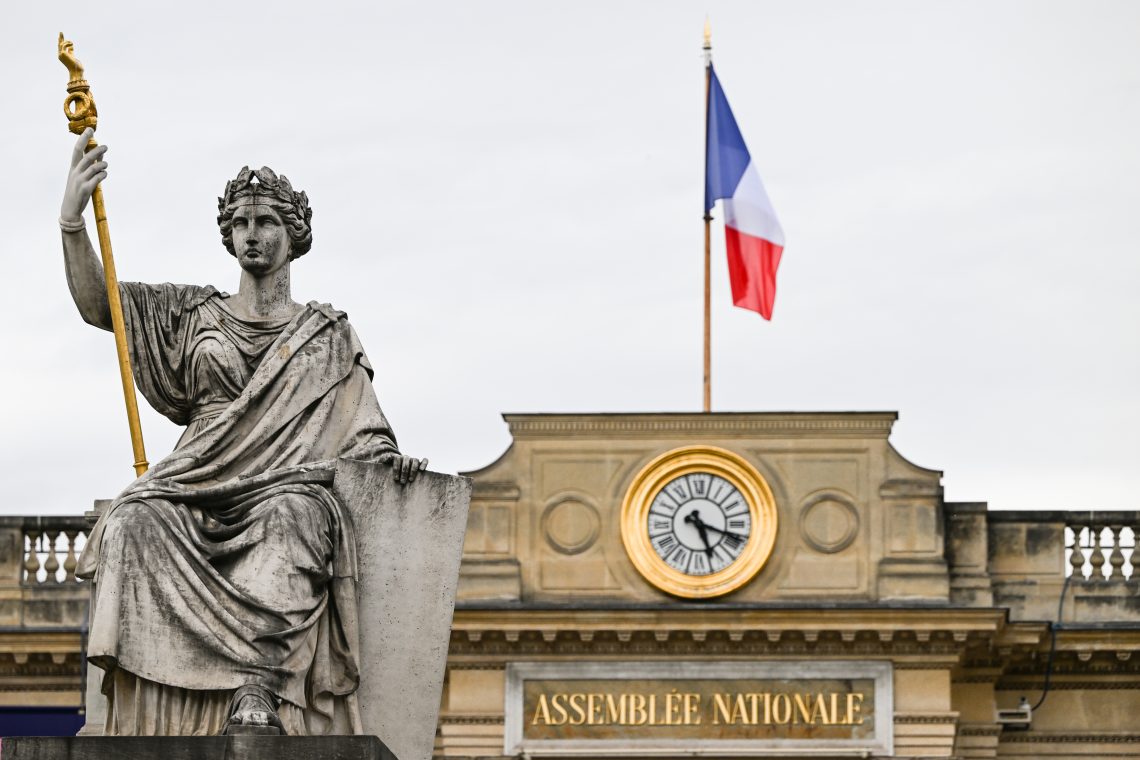
This limited optimism collides with a fragmented parliament and the difficulty of building coalitions. The result is delayed decisions, instability and legal uncertainty.
French President Emmanuel Macron’s recent appointments of loyalists to key government positions have drawn criticism. These loyalists may obscure the negative aspects of his record, constrain future far-right or far-left governments, or position him for a possible 2031 return.
Former Minister for Public Accounts Amelie de Montchalin will audit her own earlier work as head of France’s audit office. Richard Ferrand, who left government in 2017 after a conflict-of-interest controversy involving his partner, now heads the Constitutional Council, the nation’s top constitutional authority. Emmanuel Moulin, a former secretary-general to the president and cabinet member, leads the Banque de France.
Several figures close to President Macron have faced ethics questions that ended without trial. France’s Transparency International score fell sharply in 2024. Old nepotistic habits still shape the rule of law and accountability.
Many are taking to social media to denounce the mismanagement of taxpayer money and conflicts of interest. Citizens are more alert to the need for greater political accountability. Several politicians, including former president Nicolas Sarkozy, face prison sentences; former Culture Minister Jack Lang lost his position over business links to Jeffrey Epstein.
Many see the rise of the National Rally on the right and France Unbowed and the Communist Party on the left as a threat to democratic norms and legislative consensus. The picture is more mixed. The June 2024 dissolution of the lower house of parliament produced a new balance among a “central bloc” of technocrats (including President Macron’s Renaissance party), the far right and the far left. That balance has pushed both the center and the radical parties to sharpen their arguments on spending and taxation. Debates have become more informed, a shift also backed by a minority on the traditional liberal right. The change matters ahead of the 2027 elections.
Another trend is the rise of politicians who treat entrepreneurship as central. Former industry and economy minister Alain Madelin, entrepreneur and think-tank founder Rafik Smati, and Cannes mayor David Lisnard, a 2027 presidential candidate, are promoting a pro-business agenda. Think tanks such as IREF and Generation Libre support the message. It resonates with a younger generation that sees technology and artificial intelligence as sources of growth if venture capital and risk-taking are encouraged. The philosophy is largely libertarian, stressing government accountability and subsidiarity. Even parts of the radical left and right now emphasize production and business.
The great divide
Immigration remains a constant source of tension and is often treated as the main left-right divide. Twentieth-century France was rebuilt in part by migrants from Italy, Spain, Poland and African countries. Earlier European groups faced friction but eventually integrated.
Integration has been weaker for several African-origin cohorts than for earlier southern European ones. Discrimination, a wider cultural and religious gap, weaker school results for some demographics, and a labor-market regulations and welfare mix that keeps low-skilled outsiders out of work all play a part. The outcome has been exclusion, higher poverty and lasting social tension.
While many of these families want to integrate, two further facts have hardened opinion among a large share of the “native” population. First, some poor suburbs, especially in Marseille and Grenoble and, to a lesser extent, cities such as Bordeaux, have become centers of drug gangs, arms trafficking and street violence. Second, radical Islamist movements reject secular, liberal France. Both factors have deepened distrust.
Better schools, firmer security and an honest debate on Islam would help. That said, practicing Catholicism in France has been in decline since the late 18th century and collapsed after the 1960s; among the young, Catholics are now a minority. Immigration since the 1960s has also changed the population’s origins. Whether republican secularism survives that shift will depend on politics, not demography alone.
Today, restaurant kitchens, barber shops, Amazon deliveries, cleaning and security work and corner shops all rely heavily on African and North African migrants and their descendants, who accept lower pay and harder conditions. When they operate in small, low-value networks and supply chains, especially in disadvantaged suburbs, they generate limited incomes and therefore contribute less to GDP growth. That does not mean they fail to seize business opportunities or create economic activity, especially in smaller companies. By offering services at lower prices, they can also produce a modest deflationary effect, helping offset broader inflationary trends.
Scenarios
Most likely: France muddles through as debt and political fragmentation persist
Growth will stay below 1 percent. Despite stubborn deficits, default is highly unlikely: Rating agencies and European partners do not want to penalize France and trigger a European Union-wide crisis. In the short term, investors benefit from higher yields and expect European safety nets. External shocks, including those from the Middle East and recent fires, will be mitigated. The government will implement more spending cuts and raise taxes but avoid deep reform. Sovereign debt will continue to rise; by 2030, interest payments could double, putting pressure on other essential spending.
Protests will flare in isolated bursts, but they will not become a genuine revolution, and political fragmentation will persist. If passed, the controversial bills expanding legitimate self-defense for police officers could deter potential protesters, rioters and gangs. Social tensions will be contained and stability preserved by state power, though the measures would raise questions about the rule of law.
Less likely: Economic, financial and social collapse
This scenario could begin with a failed debt rollover: France cannot attract enough buyers for a new issuance and therefore cannot refinance an existing obligation. Investor defiance would follow, and yields would spike.
The trigger could be a sudden slump in fiscal revenues – perhaps a secondary effect of an oil-price shock tied to war in Iran, which would hit transport-dependent small to medium-sized enterprises hard – or an extremely costly wildfire season.
Political risk would compound the shock. Uncertainty around the next election could block meaningful reform during the next budget debate. A hidden-deficit scandal, reminiscent of Greece in 2009, would cause still more turmoil if it broke after the May 2027 vote, especially if the National Rally or a far-left president then took office.
Least likely: Reform breakthrough drives higher growth
Exceptional circumstances, like a war economy, would produce both economic stimulus and a less democratic political environment, giving the country room for strong but unpopular reforms at the expense of the rule of law. That would reduce the public deficit and, in time, sovereign debt, reassuring European partners and investors. While a major crisis that would produce such conditions cannot be ruled out, the reform scenario itself currently seems unattainable. The stimulus is overestimated and cannot offset current economic weaknesses, and the divisions in French society cannot be overcome so easily. A sub-scenario built on political consensus is equally unrealistic given the current fragmentation.
Our Partners