
Energy shocks create crises, opportunities and political cover
Following the outbreak of the conflict between Iran and the United States in early 2026, the future of global energy supplies took center stage. Although initial fears of shortages caused by geopolitical tensions have subsided, energy traders still find it difficult to predict how supply and demand will evolve.
On the supply side, the main issue is the so-called green transition, which has proven expensive and failed to deliver sufficient quantities of cheap and reliable renewable energy. Although green targets are being revised downward and private investors remain cautious, public spending continues to rise. On the demand side, artificial intelligence training and inference are consuming unexpectedly large amounts of energy. This consumption could double by the end of the decade, triggering substantial increases in energy prices.
As a result, most commentators paint a grim picture: Either the world accepts higher costs to expand the supply of clean energy or it consumes less energy. In both scenarios, living standards decline. Unsurprisingly, frequent debates over who should bear the burden – often framed by the “tax the rich” mantra – create further uncertainty.
Yet, there is also some good news. Data centers currently account for only 1.5 percent of global electricity demand and 0.3 percent of total global energy consumption. Thus, even if their electricity consumption doubles by 2030, their share of total energy consumption will rise to only 0.6-0.8 percent, depending on projections for electricity’s share of the global energy mix. The impact of AI is significant but hardly devastating.
Moreover, the data on energy efficiency is encouraging. According to the International Energy Agency, energy consumption per unit of gross domestic product has fallen at an average annual rate of 1.3 percent over the past five years. In countries such as China and India, the decline has been twice as fast. At the same time, there is no shortage of energy resources, and the situation could improve dramatically as new nuclear power plants enter service. In brief, the world is unlikely to face a severe energy constraint: Producers are constantly improving their ability to exploit resources, new sources are being developed and the efficiency of final consumption is steadily rising.
Facts & figures: Increase in electricity demand by sector in terawatt-hours, 2024-2030
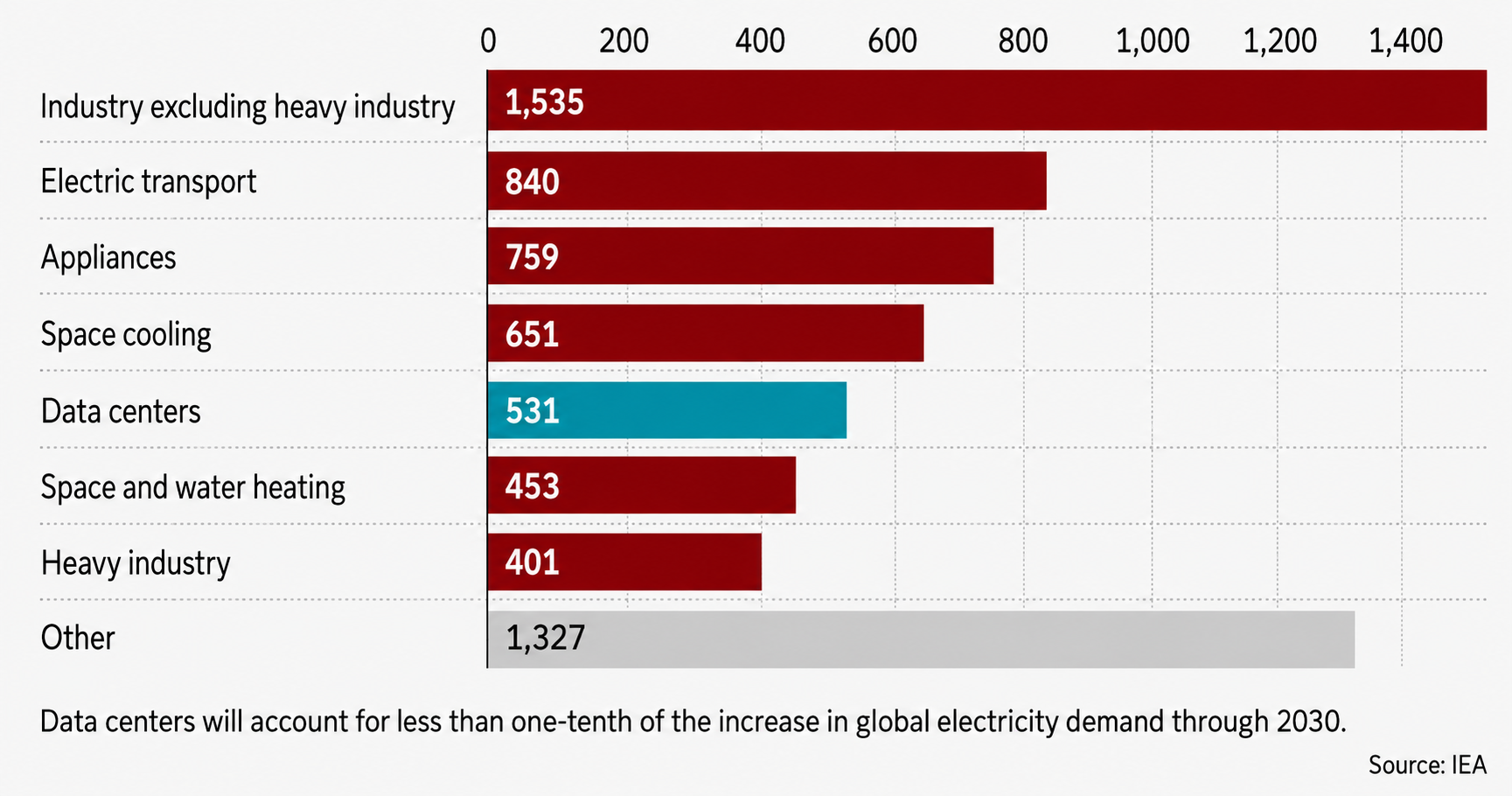
The problem is therefore not that energy is a peculiar resource whose price is bound to rise indefinitely, stifle economic growth and condemn humanity to poverty. Rather, energy prices have become volatile and include a high uncertainty premium. The causes are well known: geopolitical bottlenecks, government failures in infrastructure management, questionable choices in financing the transition to non-fossil energy production and erratic government responses to climate change.
In this light, future developments are likely to depend on three variables: innovation, supply constraints related to geopolitical tensions and governments’ efforts to exploit energy in pursuit of political agendas.
Innovation rewards risk-taking
Relative prices fluctuate with changes in consumer preferences and production costs, while competition pushes producers to innovate, meet demand and outperform their rivals to avoid losses and reward shareholders. Change and volatility therefore benefit innovators – those who invest scarce resources, including people’s savings, in industries and ventures undergoing rapid transformation and offering greater opportunities. Those with privileged access to cheap resources but little capacity for innovation, such as some oil producers, will lose ground. Although their rents may remain substantial, they will gradually erode.
Countries that lack innovation and natural-resource rents have different options. They can buy from the cheapest innovative suppliers and focus their own production on mature manufactured goods or selected services, such as finance, consulting, entertainment and healthcare. They can also reproduce innovative products and technologies developed elsewhere. Finally, their affluent residents can invest in places where innovation thrives and reap the rewards of risk-taking, even as the productivity and incomes of poorer residents stagnate or decline because of inadequate fixed investment. In the energy sector, mature economies can also rely on resources supplied by privileged producers, whose market power weakens as innovators create alternatives.
The main point is clear: Rapid change creates opportunities for entrepreneurs and risk-taking investors while punishing sclerotic economic systems. Energy makes headlines because of its geopolitical significance, its importance across numerous industries and its usefulness as a scapegoat for policy failures. Yet, it is merely the most visible manifestation of a broader phenomenon – price structures are constantly changing.
Geopolitical tensions magnify supply shocks
The international political and economic environment matters, especially for small countries outside large free-trade blocs that can soften the costs of geopolitical crises. Energy and semiconductors are cases in point. Recent events have underscored the disproportionate impact of localized conflicts: The principal threat is not trade wars but disruptions to trade routes.
Supply shocks are particularly acute when they affect oil and gas, much of which travels by sea. Areas that depend heavily on maritime supplies face deteriorating terms of trade, while the costs are distributed unevenly. Energy accounts for about 4 percent of household expenditure among high-income groups but as much as 12 percent among low-income households. The same disparity applies to food spending.
Low-income households also tend to be more heavily indebted. A surge in consumer prices can therefore cause a liquidity crisis, especially when wages adjust only partially and with a delay. The resulting social unrest has two consequences: Public finances come under pressure as governments offer tax- or debt-financed subsidies and tax relief to poorer households and powerful interest groups, while regulation expands through rationing and price controls. Both responses distort prices, strengthen interest groups and bureaucracies, and discourage innovation and energy conservation.
Energy shocks empower technocrats
Politicians and bureaucrats dislike volatility. Politicians struggle to capitalize on short-term upswings but face harsh criticism when conditions deteriorate. Bureaucrats also fear uncertainty and potential upheaval: Legislators seek scapegoats, administrative decisions come under scrutiny and mistakes can jeopardize careers. For bureaucrats, the main concern is not necessarily the energy crisis itself but its policy consequences.
Governments therefore tend to rely more heavily on technocrats or pseudo-technocrats, who promise operational effectiveness but can be blamed and quietly dismissed if necessary. In the energy sector, technocrats serve two purposes. First, they provide elaborate explanations for shocks that shield questionable past political choices and justify erratic current policies. Second, and perhaps more importantly, they assume responsibility for monetary policy when inflation rises and economic activity weakens.
Until early 2026, central bankers benefited from rising demand for money, which offset the effects of excessive money creation and kept inflation at politically acceptable levels. However, if the energy and shipping crisis subsides while the economy continues to suffer from the supply shock, demand for money will weaken. If the money supply continues to expand, inflationary pressures will intensify. Policymakers will be at a loss, leaving central bankers to take center stage, possibly with ambiguous statements. The outcome is uncertain, but the temptation to interfere in credit markets will remain strong, further increasing uncertainty.
Scenarios
Most likely: Energy and supply shocks raise the cost of political instability
Supply shocks widen divisions between geopolitical blocs while strengthening cohesion within them. Governments place greater emphasis on “shared solutions” and grand strategies – euphemisms for centralized policymaking and regulation. Energy and other crises reinforce this existing trend. Past policies are unlikely to be reversed and, at best, will change only slowly.
Less likely: Supply shocks and price inflation lead to greater inequalities
This scenario, which could occur alongside the most likely one, puts public finances under pressure and brings social tensions to the surface. The European Union is particularly vulnerable. In the U.S., supply shocks could also reshape the debate over the role of central banks and the management of public debt.
Least likely: A major power changes course
Moscow could reconsider the economic costs of geopolitical tensions, or the EU could reassess the cost of discouraging innovation. China and the U.S., however, follow different paths. Beijing is already pursuing breakneck innovation and probably views international supply shocks as a means of strengthening domestic political support and social cohesion. Washington’s direction depends heavily on the priorities of the current administration. It will take at least two years to determine whether the U.S. follows the EU’s example or changes course by limiting government efforts to regulate and interfere with entrepreneurial decision-making.

Our Partners