
China tightening its grip on Latin America
Over the past 25 years, the relationship between China and Latin America has undergone a dramatic shift. According to the Council on Foreign Relations, in 2000, China accounted for less than 2 percent of Latin America’s exports. Over the next eight years, trade grew at an annual rate of 31 percent. By 2021, bilateral trade reached over $450 billion, and it rose to a record $518 billion in 2024. Today, China is South America’s top trading partner and the second-largest trading partner for Latin America as a whole, after the United States.
China’s interests in Latin America encompass various areas, including large-scale commodity and agricultural product acquisitions, the extraction of strategic minerals, investments in energy sectors, the development of infrastructure projects, control over technology and telecommunications, as well as aerospace and military research.
As of 2024, Beijing has signed free trade agreements with Chile, Costa Rica, Ecuador, Nicaragua and Peru. More than 20 countries in Latin America and the Caribbean have joined China’s Belt and Road Initiative, with Colombia being the most recent participant.
Chinese trade in the region includes the purchase of lithium from Argentina, Chile and Bolivia, Venezuelan oil, and Brazilian iron ore and soybeans. The value of China’s infrastructure projects in Latin America and the Caribbean is estimated at $286 billion. These projects range from subway lines in Bogota and Mexico City to dams in Ecuador.
In Peru, China has invested $1.3 billion in the new Port of Chancay, a deepwater facility that became fully operational in November 2024. This port has unlocked a major transpacific shipping channel linking China and South America, bypassing traditional deepwater ports in the U.S. and Mexico.
Facts & figures: Dominant trading and investment partner in Latin America
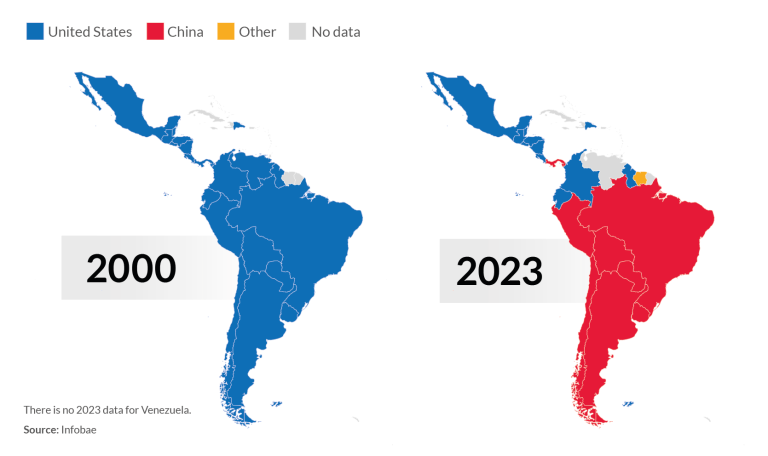 China has overtaken the U.S. as the top trade and investment partner for many South American economies.
Why China’s influence surged in Latin America
China significantly increased its investments in Latin America during the first decade of the 21st century, supported by leaders belonging to the Sao Paulo Forum (SPF), a network of left-wing political parties. This era marked the emergence of several prominent presidents, including Hugo Chavez in Venezuela, Luiz Inacio “Lula” da Silva in Brazil and Nestor Kirchner in Argentina, as well as 11 other leaders. They maintained a strong anti-American discourse and aimed to promote “multipolarity.” As a result, China emerged as a key alternative partner to the U.S.
Chavez, advised by the late Cuban leader Fidel Castro, wanted to change the regional strategic paradigm by financing like-minded candidates in other countries and fostering closer ties with China. This strategy led to a notable increase in bilateral trade between China and Venezuela. From 2007 onward, the relationship grew even stronger with the establishment of the China-Venezuela Joint Fund, which was designed to finance social, industrial, infrastructure, energy and telecommunications projects in exchange for oil. China launched a satellite program in Guarico State, establishing a major presence in Venezuelan space activities.
According to the non-governmental organization Transparencia Venezuela, from Chavez’s rise to power in 1999 through 2018, Caracas received over $62 billion in loans and $6 billion in investments from Beijing. This accounted for 46 percent of all Chinese financing in Latin America during that period.
Venezuela, a country historically associated with the U.S., shifted its alignment, making China its largest creditor. However, many of these projects remain unfinished, largely due to widespread corruption in Venezuela.
Lula as China’s key advocate in Latin America
Brazilian President Lula, who co-founded the SPF with Castro, has played a key role in fostering relations with China and Latin America. He argues that, given U.S. hegemony, it is crucial to promote multilateralism. This perspective explains Lula’s focus on strengthening the BRICS group and advocating for a currency other than the U.S. dollar as a medium of exchange.
By 2009, China had become Brazil’s main trading partner. Just 10 years later, bilateral trade had reached almost $100 billion. According to data from the Brazil-China Business Council, Beijing has invested approximately $66 billion in Brazil since 2010, solidifying its role as a key driver of national development across sectors such as energy, infrastructure, agribusiness and technology.
During his presidency from 2019 to 2023, the right-wing leader Jair Bolsonaro sought to curb Brazil’s reliance on China. However, he found this goal nearly impossible to achieve. Brazilian exporters were reliant on Chinese markets, and individual state governors often negotiated directly with Beijing, complicating efforts to shift this dependency. Four other Latin American countries are dependent on Chinese markets: Chile, Peru, Argentina and Venezuela.
Upon President Lula’s return to power in 2023, the pace of agreements with China picked up. The two countries have signed an agreement to build a rail corridor connecting the Atlantic and Pacific Oceans. The proposed Central Bio-oceanic Railway Corridor will start in Brazil, cross the border into Bolivia and continue through southern Acre, near the Peruvian border. From there, the railway line will extend to the Port of Chancay.
Facts & figures: Central Bio-oceanic Railway Corridor
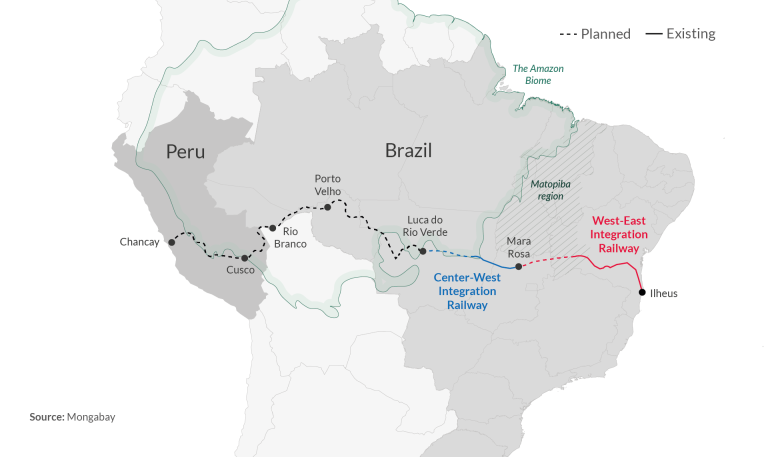
The planned railway corridor will connect the Port of Chancay in Peru to Ilheus in Brazil, aiming to boost trade between China and South America.
Beijing’s dominance of 5G and telecom networks
Chinese investments in Latin America have evolved over time. Recently, Beijing has sought to gain control of communications there by implementing 5G systems through companies such as Huawei and ZTE. Most governments in the region have been largely compliant, offering little resistance to these projects being handed over to China. Unlike Europe, there are currently no legal restrictions on these investments.
In Brazil, the National Telecommunications Agency (Anatel) announced in May 2024 that Huawei holds a 44.6 percent share of 5G infrastructure. In Argentina, China is the primary supplier of mobile networks. Peruvian operator Bitel has partnered with ZTE in a $150 million investment to deploy 1,000 5G antennas across the country. In Mexico, China recorded substantial growth in the number of 5G base stations.
Chinese data center companies have stepped up their efforts to expand their presence in Argentina, Brazil, Chile, Peru and Mexico. In early 2025, Alibaba Cloud, a subsidiary of the Chinese technology giant Alibaba Group, announced the launch of its first data center in Mexico. This initiative is part of a broader strategy to accelerate the development of Chinese digital infrastructure south of the U.S. border.
Geopolitical and military intentions
While investments may seem purely economic, China is clearly also a political actor in Latin America. Since 2016, Beijing has employed economic and diplomatic incentives to encourage countries such as Panama, El Salvador, the Dominican Republic, Nicaragua and Honduras withdraw their recognition of Taiwan. It refrains from condemning human rights violations in Cuba, Nicaragua and Venezuela. It accepted the election results announced by Venezuelan President Nicolas Maduro in July 2024, despite credible allegations of fraud. And it collaborates closely with the SPF, even participating in its meetings. China also shapes public opinion in Latin America through narratives on its social media apps.
The trade and investment network China has built in the region could serve as a platform for other types of projects. The installation of satellite stations, drone control centers or ports managed by Chinese companies could, in the future, have security implications.
In Argentina, the space observation station in Neuquen – operated by a Chinese entity linked to military-affiliated organizations – has raised concerns due to restricted access for local officials and its potential dual-use capabilities. Since 1984, Brazil and China have been collaborating in the satellite sector. This partnership includes the development of communication, remote-sensing and image-processing satellites, along with the launch of various rockets.
The Chinese government’s strategy for Latin America, outlined in its 2016 Policy White Paper, has emphasized the importance of security and defense cooperation. It explicitly states that China seeks to:
[a]ctively develop military exchanges and cooperation with Latin American and Caribbean countries; expand friendly contacts between military and defense leaders, strengthening political dialogue and establishing working meeting mechanisms; conduct mutual visits by delegations and military vessels; deepen professional exchanges in the areas of military training … and strengthen arms trade and cooperation in military technology.
Chinese military diplomacy has outpaced that of the U.S. in certain areas, especially in the number of Latin American officers studying at Chinese military academies. By 2020, this number was five times higher than the U.S. figure, a trend that had been accelerating since 2015.
The Trump administration’s response
As U.S. Secretary of State Marco Rubio has recently pointed out, the Trump administration has decided to shift strategy, placing greater emphasis on the Western Hemisphere. “I would say that if you are focused in America, and America First, you start with your own hemisphere, where we live,” said Mr. Rubio.
President Trump has asserted that China is attacking the U.S. by smuggling fentanyl through cartels operating in Mexico and other countries. He has also criticized China’s growing influence in the region. In his inaugural address, Mr. Trump expressed his desire to “take back” the Panama Canal, referring to Chinese presence around this important waterway. Less than two months later, the U.S. firm BlackRock agreed to acquire two ports located at both ends of the canal from a Hong Kong-based company. Beijing is trying to prevent the sale.
In Argentina’s October 2025 legislative midterms, President Javier Milei’s La Libertad Avanza party secured a commanding victory, while National Party candidate Nasry Asfura won the presidency in Honduras’s November 2025 general election. Mr. Trump openly backed his right-wing allies in these contests.
In Venezuela, on January 3, 2026, U.S. forces launched a military operation involving strikes in Caracas and other locations, capturing President Maduro and his wife, who were flown to the U.S., where they are now detained and facing federal charges in New York. Following his capture, Venezuelan Vice President Delcy Rodriguez was sworn in as acting president. In return for easing sanctions, allowing oil production to resume and supporting the interim government, President Trump has demanded political alignment with Washington. This includes expelling Chinese, Russian, Iranian and Cuban influence by severing economic ties with them and partnering primarily (or exclusively) with America.
Mr. Trump has also warned of potential action against figures like Colombian President Gustavo Petro and suggested the Cuban regime may soon collapse.
To make a successful transition away from reliance on Chinese markets, it is important for the U.S. to invest in initiatives that provide substantial financing and purchasing power for U.S.-made products. Without this support, it will be nearly impossible for Latin American countries to shift their dependencies.
Scenarios
Most likely: U.S. intervention slows China’s advance
In the 2026 electoral year, right-wing candidates supported by the Trump administration continue to secure victories throughout the region. This coincides with the restoration of democracy in Venezuela following the capture of Mr. Maduro, signaling a decline for the allies of the SPF.
Incoming presidents choose to limit relations with China, slowing new investments in strategic areas like technology and telecommunications. They prioritize American and European investments – especially countries of Mercosur, which is in the final stages of concluding a free trade agreement with the European Union − in these sectors and gradually reduce dependence on China.
This presents a valuable opportunity for Western banks and companies to invest in a region rich in diverse resources, including oil and strategic minerals. The population in this region not only speaks a similar language but also shares the values of Western Christian civilization.
The main obstacles to overcome are, first, the power of drug cartels, which must be dismantled, as Washington intends to do. And second, the fragmentation of Latin American markets into 20 distinct countries.
The newly elected right-wing governments in Latin America create a regional integration mechanism. This initiative will allow them to negotiate agreements as a unified bloc with the U.S. and Europe, aiming to present a market of 600 million people. This would reduce investment risks and could offset China’s influence.
Less likely: Lula is reelected and Trump pulls back
President Lula wins reelection in October 2026. Concurrently, President Trump is compelled to reduce his actions against drug cartels, primarily due to pressure from the U.S. Democratic Party and the constraints imposed by the Mexican government on the war on drugs.
A coalition is formed among the leftist leaders of Brazil (Lula), Mexico (Claudia Sheinbaum) and Uruguay (Yamandu Orsi), enabling SPF members to regroup and reorganize. Despite a regional shift toward right-wing politics, President Lula successfully persuades some countries to join BRICS and strengthen their agreements with China.
The U.S.-China dispute in Latin America intensifies. Consequently, countries in the region miss a historic opportunity to dismantle the cartels and establish regional integration mechanisms that would enable them to take a more relevant position in the global economy.
This report was originally published here: https://www.gisreportsonline.com/r/china-latin-america-2/
Our Partners