
A mirror for Europe
The United Kingdom’s prime minister, Sir Keir Starmer, visited Beijing last week, leading a delegation of top British business people for meetings with President Xi Jinping. The prime minister stated “China matters,” leaving room for interpretation. A similar visit was carried out by French President Emmanuel Macron in December, and German Chancellor Friedrich Merz plans to travel there at the end of February.
The administration of United States President Donald Trump has in many respects been criticized by European leaders and media. Indignation and complaints are rife, and this is not limited just to tariff policies and Greenland: Everything this administration does meets criticism, whether justified or not.
The European mantra is that the Trump White House is anti-European and breaks international law. In fact, the so-called rules-based world order existed only as long as the U.S. enforced it. Now Washington wants other countries − its allies, nations that have been protected by the U.S. − to take an equal share of the burden.
A hypocritical path paved with good intentions
The problem is that the old continent has long felt it convenient to neglect its security, taking American protection for granted. On top of that, European countries and Brussels indulged in creating endless feel-good and ideological rules and procedures, resulting in an impossible regulatory framework. Economic policies were driven by costly, doctrinaire projects such as the European Union’s green taxonomy. These attitudes came from member states, the European Commission and the European Parliament. Just blaming Brussels would be wrong.
More recently, politicians claim that some of the overly protectionist rules, such as the Supply Chain Directive, have been eased. But this scaling back is mere window dressing; the expensive and bureaucratic luxury of oversized states is accepted and remains untouched.
As an example of bloated and unproductive economies, the eurozone in the final quarter of 2025 had a growth rate of just 0.3 percent. While this is already bad, the shocking part is that the meager growth was only due to everything increasing through debt-financed government expenditure. The real economy is contracting. The reasons are overregulation and excessive energy prices, primarily in Germany, caused by populist and ideological policies.
The regulatory zeal has backfired. It has made the European economy less competitive and its productivity suffers compared to other regions of the world.
As a result, Europe’s economic and political competitiveness, as well as its resilience, have suffered drastically. But still, although larger efforts in defense are now envisaged and some European countries are implementing defense measures, the old continent continues to believe in its role as a “regulatory superpower.” The obtuse logic of this protectionist arrogance is the following: The European market is so important that, in order to gain access, the entire world must adhere to its purportedly values-based rules to protect consumers and the environment.
The regulatory zeal has backfired. It has made the European economy less competitive and its productivity suffers compared to other regions of the world. Striking cases are AI regulation and the Digital Services Act. The latter was created to contain American providers, but both are frustrating the success of European businesses in this area. It brings to mind the protectionist isolation of China in the 18th and early 19th century, which resulted in the “century of humiliation.”
Europe’s self-inflicted wounds
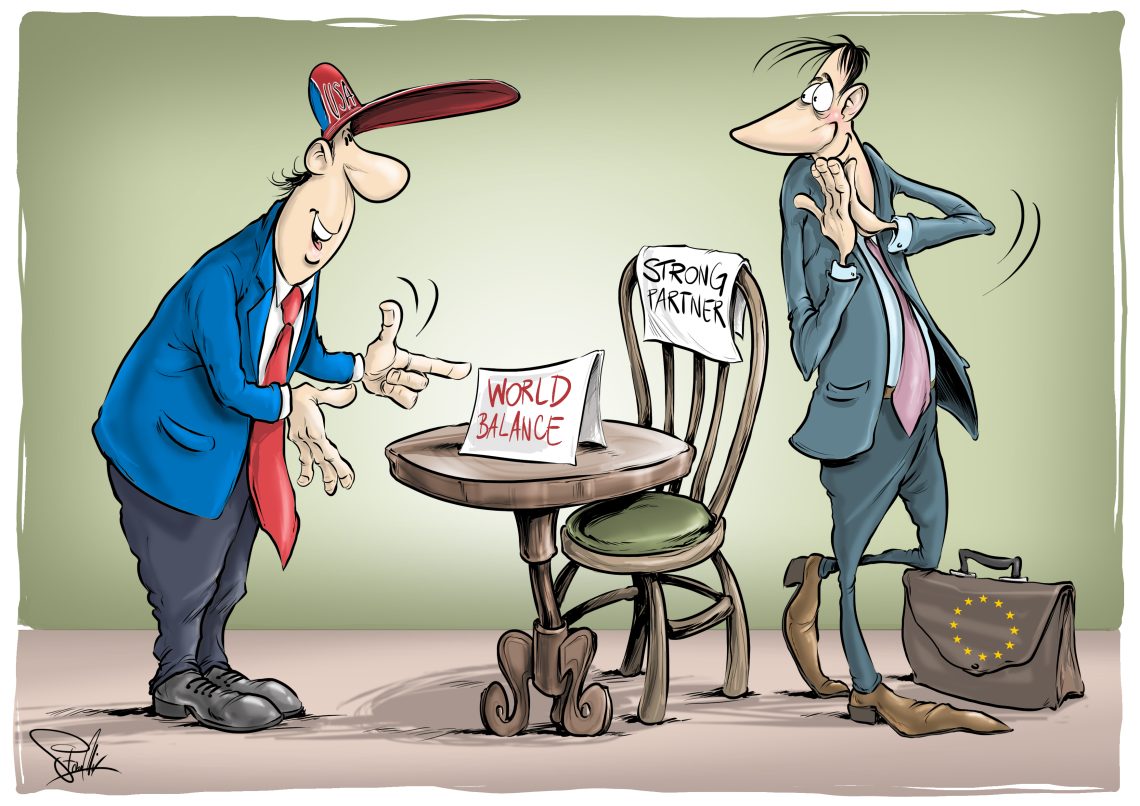
It is not Washington’s fault that Europe is weak in dealing with the U.S. It is a problem of Europe’s own creation. Concerning Greenland, there is no denying that Europe totally neglected the essential issue of defense in the Arctic. This gives President Trump an important point in the present context of rising geopolitical tensions. The U.S. needs and wants strong allies and this is legitimate. It is very healthy when the Trump administration puts a mirror in front of the Europeans.
Europe should finally become realistic and enhance the economy by drastic deregulation and reducing the extent of public administration, freeing it up to finance its defense and an interest-driven foreign policy. This would allow the continent to maintain a healthy and strong alliance with the U.S., which Washington wants, instead of continuing to protect a whining child.
An economically strong Europe, coupled with efficient military power, decisive − not weak nor dogmatic − leadership and pragmatic foreign policy could help to maintain fair international relations.
The trips to Beijing give the impression that Europeans are choosing China in defiance of Washington. Certainly, “China matters,” but the real friend of Europe is the U.S. Europe has to become fit to engage with Washington on a level playing field. This is what President Trump requested in his speech in Davos, which resulted in indignation. Instead of complaining about the president, finger-pointing and trying to play a highly dangerous and short-sighted game between the U.S. and China, Europe should simply get its act together.
This comment was originally published here: https://www.gisreportsonline.com/r/mirror-for-europe/
Our Partners