
2nd Award in Vernon Smith Prize 2025
Dinner for One, served by the poor? How our micro-cosmic intuitions mislead us in a macro-cosmic world
Vincent Czyrnik
ABSTRACT
This essay uses the familiar New Year’s Eve sketch Dinner for One as an entry point to examine a central question in political economy: why do widespread perceptions of injustice persist despite historically unparalleled increases in living standards for both the rich and the poor? By contrasting the living conditions of “Miss Sophie” and “James” in 1920 with their modern counterparts, the essay shows that real incomes have risen across the entire income distribution, even if inequality has increased moderately. To explain why these gains are routinely overlooked, the essay applies Hayek’s distinction between the micro-cosmos of small-group morality and the macro-cosmos of the extended order. Drawing on work in evolutionary anthropology, moral psychology, and economic ethics (Bowles and Gintis; Greene; Clark and Lee), it argues that moral intuitions shaped in small-group environments are systematically misapplied to large-scale market societies. These misplaced intuitions fuel contemporary policy proposals such as tariffs, limitarism, and deglobalisation, which promise fairness but threaten the institutional framework that made today’s prosperity possible. The essay concludes that, just as families annually gather to watch Dinner for One, we should cultivate an annual reflection on Hayek’s distinction between the micro- and the macro-cosmos.
Introduction
On New Year’s Eve, as tradition has it in many European living rooms, people gather to watch Dinner for One—a curious sketch in which a lavish banquet is prepared, but only one guest ever eats. The central figure, Miss Sophie, celebrates her birthday alone, surrounded only by the memories of her long-departed friends. Her butler, James, fills the void by impersonating each absent guest, raising a glass on their behalf until he stumbles across the stage in drunken exhaustion. For this essay, we do not want to dwell on Miss Sophie’s long departed friends. Rather, the focus should be on Miss Sophie, on James, and on those who are not even imaginatively part of the scene. These are the people who never sit at the table: the peasants who work the land, the cooks who prepare the feast, and even James, who stands at the very end of the chain of production to serve the meal.
Miss Sophie may be read as a symbol of a British wealthy lady at the beginning of the twentieth century. As a member of the upper class, she has no reason to interrupt the banquet despite the absence of her long-departed friends. Her wealth is so abundant that she can continue the ritual without questioning its purpose. On the other side, James, the cooks, and the peasants must work hard for the meal and for the modest wages it brings them.
Even as the sketch provokes laughter every New Year’s Eve, it also leaves a lingering question: how can a feast for one, sustained by the labor of the relatively poor, ever be fair? This essay approaches the question by first examining how living standards for both Miss Sophie and James have evolved over the past century. It then turns to the underlying conceptual puzzle: why, despite broad increases in prosperity, do many perceive the modern world as increasingly unjust? To address this, the essay draws on Hayek’s distinction between the micro-cosmos of small-group morality and the macro-cosmos of the extended order. I argue that the persistent outcries over injustice stem from the attempt to force macro-cosmic problems into a micro-cosmic mold. Yet history shows that such attempts tend to achieve the very opposite of what they are intended to accomplish.
FROM DINNER FOR ONE TO 2020S BRITAIN: A CENTURY OF RISING LIVING STANDARDS
Determining the exact time at which Dinner for One is set requires some interpretation, but several clues narrow it down. The presence of electric lighting suggests that the story cannot take place before the early twentieth century. Electricity began to enter British homes in the 1890s, yet at the beginning of the 1910s, it remained an exclusive privilege of the upper class rather than a common household feature (McGarry, 2023).
For simplicity, and because more reliable data are available, let us take the year 1920 as a reference point. At that time, an ordinary worker earned between £ 2 and £ 4 per week (Bank of England, 2025). With this income, he could afford a small, cramped dwelling heated by a coal stove, usually without electricity and with a shared outdoor toilet (Bowley & Hurst, 1931). Roughly half of his earnings went toward food, while meat
remained a luxury, as the tradition of the Sunday roast reminds us. James and the cooks probably lived on Miss Sophie’s estate, sharing a servants’ room, or, if they were lucky, having a small one of their own. Their days were long and exhausting, and the notion of a holiday did not exist in their world. In contrast to this, Miss Sophie visibly belonged to a much higher income group. She likely owned her own house or even an estate, employed a small staff, and could afford occasional holidays along the French Riviera. Her social world included leisure activities such as horse races, the theatre, and dining in elegant restaurants—even without her long-departed friends. She would have been driven to these events in one of the new automobiles of the time, chauffeured. In her home, she almost certainly enjoyed electric lighting, running water, and at least one
private bathroom, if not several (ibid.). It is estimated that the richest one per cent of Britons earned roughly ten to twenty times as much as the average worker at the time (Atkinson & Piketty, 2007).
Now consider how Miss Sophie might live as a member of the top 1 percent or even the top 0.1 percent in 2020s Britain. To belong to the top 1 % of income earners today requires an annual pre-tax income of roughly £160,000, or about £3,000 per week (Joyce et al., 2019). With such an income, Miss Sophie could likely afford a stylish loft apartment in London and travel in business class to exclusive holiday destinations around the world. If she belonged to the top 0.1 percent, the business seat might well give way to a private jet. At that level—earning around £650,000 a year, or more than £12,000 per week (ibid.)—her London flat would probably be complemented by a countryside estate in Surrey or a seaside residence in Cornwall. Depending on her taste, she might own a supercar, a small yacht, or even a collection of fine art and antiques. And unlike in the original Dinner for One, her long-departed friends might still be around to join her, thanks to the miracles of modern medicine. All in all, Miss Sophie has become even wealthier than she was a hundred years ago: the rich have indeed become richer.
But what about James and his colleagues in the kitchen or out in the fields? A hundred years ago, they might have shared a small room in Miss Sophie’s estate, working far beyond forty hours a week and living on modest daily meals. Today, their lives would look entirely different. The average Briton earns around £680 per week in 2020 (Bank of England, 2025), enjoys a private apartment with running water, reliable electricity, and central heating. Most households have broadband internet, a television or computer, and a smartphone. Access to healthcare is universal, and modern conveniences, from refrigerators to washing machines, have turned what was once luxury into ordinary comfort. In short, James and his companions are far better off today. The poor, too, have grown richer.
When we take these estimates into account, a slight increase in the Gini coefficient, as the standard measure of inequality, becomes apparent. Yet this should not distract from the central fact that real incomes have risen for everyone; the rich have simply advanced more quickly. Figure 1 clarifies this relationship. James, as a representative of the poor, has become richer, and Miss Sophie, as a representative of the rich, has become richer even more rapidly. As a side note, it is worth mentioning that inequality has historically tended to decline under two conditions: war and socialism. Yet in both cases, overall prosperity falls—the rich and the poor become poorer alike.
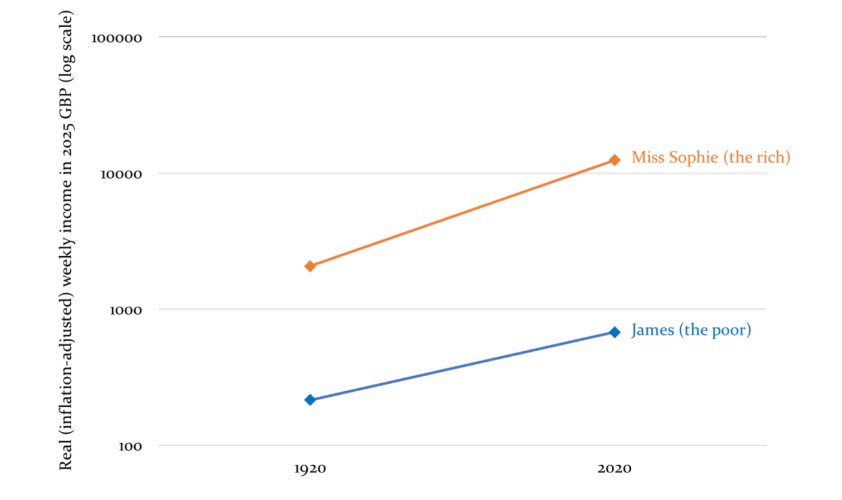
Figure 1. Real annual incomes of James (average earner) and Miss Sophie (top 1%) in 1920 and 2025 (log scale). Own illustration based on Atkinson and Piketty (2007), Bank of England (2015), and Joyce et al. (2019).
HAYEK’S MICRO-COSMOS AND MACRO-COSMOS
I have shown that while the rich have become richer, the poor have also become richer. Why, then, do the Pikettys and Sandels of this world cry out in a different direction—claiming that the world is becoming ever more unjust and alarmingly unequal? (A claim, by the way, that does not hold up when one considers more recent data, such as Auten and Splinter (2024) or Waldenström (2024), which challenge Piketty’s calculations on inequality.)
I identify one main reason behind this outcry of perceived injustice and inequality. Most people are unable to separate their moral intuitions from empirical reality. And this is an answer to the question, scholars have struggled with since the Enlightenment: why do bad ideas so often succeed in capturing the minds of many? I maintain that Hayek captured the essence of the problem, an insight that keeps resurfacing across diverse academic disciplines.
As Hayek (1988, p. 18) writes, we must distinguish the „rules of the micro-cosmos (i.e., of the small band or troop, or of, say, our families) to the macro-cosmos (our wider civilization).“ To grasp the logic of the micro-cosmos, we may look to the work of Bowles and Gintis (2011), who explore the evolutionary roots of human cooperation and morality. They argue that our intuitive moral compass developed in the context of small-group life during the Stone Age, when humans lived in tightly knit bands of roughly a hundred individuals. In such settings, morality served a clear functional purpose: it promoted cooperation within the group and, in doing so, increased the group’s chances of survival against other, potentially hostile bands. This morality framework rewarded loyalty, reciprocity, and fairness toward one’s own group members, while simultaneously punishing cheaters and free riders harshly and immediately. At the same time, life operated as a zero-sum game: whatever one person gained necessarily came at someone else’s expense. But the logic of the micro-cosmos cannot be applied to the modern world. From the nineteenth century onward, we witnessed what Clark (2007) calls the “Great Divergence,” during which sustained increases in per-capita income emerged for the first time in human history. As a result, the world became a positive-sum game, with wealth rising for the Miss Sophies and the Jameses of the world, as I have shown in the previous section.
Our moral intuitions, however, stem from the Stone Age, and we continue to think in ways that reflect this ancient environment. This is captured perfectly in a verse attributed to Bertolt Brecht:
Rich man, poor man faced each other in a van.
Said the poor man with a switch:
‘Were I not poor,
you wouldn’t be rich.’1
1 The translation of Brecht‘s “Reicher Mann, armer Mann” quoted here has been informally associated with David Constantine; however, a definitive attribution could not be established.
Even though this view has intuitive appeal, it does not correspond to the empirical realities of the macro-cosmos.
This misapplication of micro-cosmic intuitions to macro-cosmic realities is a recurring theme addressed in the academic literature. In moral psychology, for example, Greene’s dual-process theory (e.g., 2008) highlights a similar distinction: we judge situations using two different cognitive systems (closely related to Kahneman’s System 1 and System 2) but applied specifically to moral judgment. Greene argues that one system is fast, emotional, and well-suited for the intimate, face-to-face dynamics of the micro-cosmos, while the other is slow and abstract, allowing us to reason about the impersonal, large-scale structures of the macro-cosmos. A similar point is made by Clark and Lee (2011) in their conceptual essay, where they distinguish between mundane morality and magnanimous morality. The former refers to the impersonal, rule-based ethics that govern market interactions: honesty, contract-keeping, respect for property, and the avoidance of harm. The latter, by contrast, reflects the morality of small groups: personal generosity, altruistic sacrifice, loyalty to one’s immediate circle, and the expectation of mutual care. While magnanimous morality works well in families or tight-knit communities, it becomes dysfunctional when applied to the large, anonymous settings of the macro-cosmos. At their core, these diverse frameworks converge on the Hayekian idea: that the rules of the micro-cosmos cannot simply be projected onto the macro-cosmos, and vice versa.
If people were asked to reflect on the Dinner for One scene in moral terms, many would instinctively focus on the apparent inequality between Miss Sophie and James. James’s weak bargaining position seems to trap him in Miss Sophie’s absurd ritual, jeopardizing his health through the sheer volume of alcohol he is required to consume. But fortunately, despite the sketch’s playful atmosphere, Miss Sophie and James are not part of a small tribal community governed by the norms of the micro-cosmos. Instead, they are engaged in a professional economic relationship of the macro-cosmos. Here, James is free to quit his job without risking exclusion from the tribe, which provides his basic survival resources. Here, James can take breaks because his contractual rights ensure that he can. And here, James is entitled to a wage at all, and he would not be expected to serve Miss Sophie out of loyalty and communal affection. Overall, being situated in the macro-cosmos offers substantial advantages for James. Furthermore, the macro-cosmic structure of the modern economic order has played a central role in raising the living standards of the Jameses by a factor of five over the last hundred years.
If, instead, we were to impose the morality of the micro-cosmos onto the macro-cosmos, as history has shown during socialist experiments, Miss Sophie’s position would quickly erode. She would have to ensure that James shared her wealth, inevitably diminishing her own. But the truth is that the prosperity of the broad masses, here illustrated by James, did not improve meaningfully under such socialist experiments. A fivefold increase in living standards over the past century, and an estimated thirteenfold increase over the past two hundred years for the Jameses (Clark, 2005), as seen in modern capitalism, would be unthinkable within a purely micro-cosmic world. The Pikettys and Sandels of the world, who seek to improve the situation of people like James by forcing the macro-cosmos into a micro-cosmic mold, ultimately end up making Miss Sophie’s and James’ situation worse.
THE DINNER FOR ONE IN 2025
Once again, this New Year’s Eve, many families will find themselves in front of the television to watch Dinner for One. Coming out of the Christmas period, they will have tasted the comforts of the micro-cosmos: being surrounded by family, sharing food, exchanging gifts, and relying on unspoken norms of mutual care. And yet the very comforts of the micro-cosmos rest on the results of a macro-cosmic social structure. The gifts are electronics from rising industrial nations, the wine arrives from distant countries, and the roast is of the finest quality. A century ago, such goods were the exclusive domain of Miss Sophie. She could have gifted her hypothetical grandchildren the exquisitely crafted dollhouses with electric lighting, opened a bottle of fine Bordeaux claret, and celebrated Christmas with roast goose. James, by contrast, might have given his children simple clothes, poured himself a mild ale, and celebrated Christmas with nothing more than a small chicken.
Today, Miss Sophie would likely spend Christmas even more exclusively: depending on her taste, she might escape to warm Dubai for the holidays, staying in one of the world’s most luxurious hotels and dining in some of its most exclusive restaurants. But James would live far better today than Miss Sophie did in the 1920s. His children receive consumer electronics that far surpass the electrically lit dollhouses of the 1920s era, he can choose from a global selection of affordable wines that he can order on Amazon.com, and his food options range across an entire world of cuisines—many of which can bedelivered straight to his door via Uber Eats. All of this is possible only because successive generations have resisted the temptation to let micro-cosmic intuitions override macro-cosmic institutions. Had it been otherwise, both Miss Sophie and James would find much less on their tables today—at Christmas, and even on New Year’s Eve.
In today’s public discourse, micro-cosmic intuitions manifest themselves in calls for tariffs to protect local industries, in limitarian arguments for capping personal wealth, and buy-local initiatives rooted in small-group preferences. Hayek recognised that anti-macro-cosmic resentments are recurrent phenomena, continually reappearing under new labels. Hence, it should become a tradition not only to watch Dinner for One each year, but also to return each year anew to Hayek’s distinction between the micro- and the macro-cosmos.
Vincent Czyrnik is early-career researcher in sustainable innovation, economic ethics, and governance of emerging technologies, with experience in classical-liberal civil society organizations. Currently works as Doctoral Research Associate/Lecturer (wiss. Mitarbeiter) at Martin-Luther-Universität Halle-Wittenberg (MLU), Department of Economic Ethics.
References
Atkinson, A. & Piketty, T. (2007): Top Incomes over the Twentieth Century. Oxford: Oxford University Press.
Auten, G. & Splinter, D. (2024): ‘Income Inequality in the United States: Using Tax Data to Measure Long-Term Trends’, Journal of Political Economy, 132, pp. 2179–2227.
Bank of England (2025): ‘Average Weekly Earnings Per Person in the United Kingdom (AWEPPUKQ)’, retrieved from FRED, Federal Reserve Bank of St. Louis, 19 November 2025. Available at: https://fred.stlouisfed.org/series/AWEPPUKQ
Bowles, S. & Gintis, H. (2011): A Cooperative Species: Human Reciprocity and Its Evolution. Princeton, NJ: Princeton University Press.
Bowley, A. L. & Burnett-Hurst, A. R. (1931): Wages and Income in the United Kingdom since 1860. Cambridge: Cambridge University Press.
Clark, G. (2005): The Condition of the Working-Class in England, 1209–2004: Working Paper. University of California, Davis.
Clark, G. (2007): A Farewell to Alms: A Brief Economic History of the World. Princeton, NJ: Princeton University Press.
Clark, J. & Lee, D. (2011): ‘Mundane Morality and Magnanimous Morality’, The Independent Review, 15(3), pp. 325–342.
Greene, J. (2008): ‘The Secret Joke of Kant’s Soul’, in: Sinnott-Armstrong, W. (ed.), Moral Psychology, Vol. 3. Cambridge, MA: MIT Press, pp. 35–80.
Hayek, F. A. (1988): The Fatal Conceit: The Errors of Socialism. Chicago: University of Chicago Press.
Joyce, R., Pope, T. & Roantree, B. (2019): The Characteristics and Incomes of the Top 1%. London: Institute for Fiscal Studies. Available at: https://ifs.org.uk/sites/default/files/output_url_files/BN253-Characteristics-and-Incomes-Of-The-Top-1%252525.pdf
McGarry, T. (2023): UK Electricity Capacity and Generation by Fuel between 1920 and 2020. London: UK Department for Energy Security & Net Zero. Available at: https://assets.publishing.service.gov.uk/media/649c1c69b4d6ef0012039055/UK_Electricity_capacity_and_generation_by_fuel_between_1920_and_2020.pdf
Piketty, T. (2022): A Brief History of Equality. Cambridge, MA & London: The Belknap Press of Harvard University Press.
Waldenström, D. (2024): Richer and More Equal: A New History of Wealth in the West. Cambridge: Polity Press.



Our Partners