An algorithm for delimiting state intervention
The doctrine of the liberal state’s upper bound: An algorithm for delimiting state intervention
One of the most fundamental and contested questions in political science concerns the proper functions and scope of the state. Its importance is such that it may plausibly be regarded as the central question of political theory. Different schools of thought define the state in accordance with the degree of authority they deem legitimate in governing social order. These disagreements are not limited to rival ideological traditions; even within a single intellectual current, and sometimes within a single political party, a wide range of interpretations exists. This plurality of views has ensures that the question of what tasks should be entrusted to the state remains central to political inquiry.
This debate extends beyond academic and elite discourse. It is also a central theme in electoral politics and in public justification of what is considered an acceptable level of state intervention in social and economic affairs.
This article develops a coherent framework for defining the functions and scope of the state from a classical liberal perspective. It aims to construct a theoretically defensible model with minimal internal contradictions, while fostering greater convergence among liberal perspectives and enhancing their persuasive power in public discourse.
In this regard, the paper first revisits the philosophical foundations of the state within the liberal tradition. It then identifies the core functions that may legitimately be assigned to the state. Finally, it advances an algorithmic decision framework for assessing the legitimacy of state intervention across policy domains—one that is intended to be applicable independent of time and context, and to serve as a practical guide for policymakers.
The foundation of liberalism rests on the protection of individuals’ natural rights. Early exponents of this tradition were among the first to conceptualize the individual as an autonomous rights-bearing agent, independent of tribe or religious sect, placing the individual at the center of political analysis. This intellectual shift was so profound that it constituted a paradigmatic shift in the study of politics and public order.
Within this analytical scheme, human life—and the protection of the right to life—serves as then starting point for the articulation of all other rights and obligations. The right to survival necessarily implies access to food and to the means required to sustain one’s livelihood. Accordingly, property rights over tools of production, agricultural land, or stored wealth used for exchange in acquiring food appear fully justified.
If individuals, despite formally holding property rights, are unable to make use of their assets, their very survival may be placed at risk, thereby resulting in a violation of their most fundamental right. Accordingly, the liberty to use one’s property is treated as equal in status to the rights to life and property themselves.
Just as natural rights appear self-evident for every individual and their protection is regarded as an inherent and indisputable obligation, non-interference with the rights of others is likewise defined as a core duty owed between individuals. In this way, an implicit social contract arises, under which individuals mutually recognize each other’s natural rights and refrain from violating them.
However, since some individuals may choose not to comply with this norm and may seek to infringe upon the rights of others, the right of self-defense for the victims of such violations appears equally self-evident. Yet because individuals may lack the necessary capacity to defend themselves, or may apply sanctions against violators in a subjective and disproportionate manner, the existence of an institution becomes necessary.
Such an institution would define what constitutes a violation, determine proportionate sanctions, and intervene when rights are infringed in order to protect citizens. This provides the minimal normative justification for the state as a mechanism for enabling peaceful coexistence among individuals. In this sense, the only legitimate basis for the existence of the state is the establishment of the rule of law and the protection of individuals’ natural rights.
Violations of natural rights are not confined to the boundaries of a neighborhood or a single city and may equally be committed by actors located in distant regions. Therefore, the geographical scope of state authority is limited to territories in which individuals have, through an implicit social contract, consented to its sovereignty. This is where the concept of the nation-state becomes more clearly articulated, and the modern understanding of a country emerges as a territorial unit under a single authority responsible for the enforcement of the rule of law.
Rights violations are not limited to infringements of private property. The appropriation of public resources or damage to them also constitutes a violation of collectively held assets. Moreover, without access to shared resources—such as groundwater reserves, which are often physically nonexcludable, or clean air, which can be degraded through human activity and impose external harm on others—sustaining human life becomes impossible.
In the absence of effective market mechanisms, there arises a need for an institution capable of regulating resource extraction and determining compensation for harm inflicted. Such an institution must possess sovereign authority, render binding decisions for all, and enforce proportionate sanctions in cases of non-compliance, as such violations amount to breaches of individuals’ natural rights.
It is also possible that violations of natural rights do not arise from other individuals or states, but rather from natural disasters. Earthquakes, floods, tsunamis, or the outbreak of diseases are among the events that may result in the “imminent loss of life” for the population of a given region.
In most cases, responding to such disasters lies beyond the capacity of individuals acting separately. Moreover, due to the unpredictability of their occurrence and the scale of the resulting damage, the private sector may lack both the capacity and the incentive to invest in adequate preventive or mitigative measures. In such circumstances, the state is expected—consistent with its only legitimate function, namely the protection of individuals’ natural rights—to adopt temporary and limited measures aimed at preventing or reducing harm.
In this sense, the state functions analogously to a protective agency, akin to an insurance mechanism, while taxation is interpreted as a form of membership fee for participation in society. Such contributions must be treated as equal in nature, and no payment beyond this basic membership obligation can be considered justified.
Thus, the existence of the state is not necessary except in cases of necessity or exigency, in which an immediate and direct violation or threat to individuals’ natural rights can be clearly established. In such cases, state intervention is only legitimate under the following condition:
1. The issue falls within the exclusive jurisdiction of the state. The protection of national borders, the declaration of war and peace with other states, the establishment of diplomatic representation in international forums, the collection of overflight and transit fees, and the management of shared public resources are among the matters that require the unique and sovereign authority of the state, as they are inherently beyond the legitimate capacity of the private sector.
2. Issues for which the private sector, despite the absence of legal or institutional barriers, lacks sufficient economic incentive under competitive conditions to act. This condition can only be invoked where the sustained absence of market formation over a significant period of time, under competitive conditions, can be empirically demonstrated.
Examples include the construction of flood barriers along riverbanks or the implementation of measures to prevent landslides in mountainous regions—areas in which the private sector typically lacks sufficient economic incentive to invest due to poor cost-benefit alignment. Even investment in basic public goods such as primary education, waste collection, or potable water treatment—services whose absence in the contemporary context poses an immediate and direct threat to human life—falls within this category.
Although these functions may, in principle, be within the scope of private provision and are often more efficiently delivered by private actors than by the state, the absence of private entry necessitates state intervention. Such intervention, however, is justified not as a means of improving overall welfare, but strictly to the extent required to eliminate imminent threats to individuals’ natural rights.
3. Activities for which the private sector lacks sufficient capacity to provide nationwide coverage, even at a minimal level. In many low-income countries, the private sector does not possess the necessary scale or capability to ensure the universal provision of essential goods and services required for the preservation of life.
The establishment of healthcare facilities in remote areas, or the provision of adequate transportation infrastructure to ensure access for all citizens across a country, are examples of such cases. Even where economic viability may exist in principle, the fragility of the private sector or the long payback periods involved often discourage private entry into these domains. In this framework, the provision of these minimum services by the state remains justifiable, albeit in a limited and temporary form, as part of its role as the guarantor of individuals’ natural rights.
However, such interventions must be designed with the explicit objective of enabling market development and ensuring the gradual withdrawal of the state over time. It follows that it is possible to design an algorithm that clearly and systematically defines the permissible scope of state intervention based on the temporal and spatial conditions of each country, thereby serving as a practical guide for liberal policymakers.
However, this flexibility should not be interpreted as the absence of a clear boundary for state action. Beyond circumstances in which an immediate and direct violation or threat to natural rights can be established, any form of state intervention lacks normative legitimacy—even when justified in terms of welfare gains, distributive equality, or developmental objectives.
In other words, while the framework allows for a limited degree of variability in the level of intervention, it simultaneously establishes a strict and non-negotiable upper bound on state action. Under this constraint, the state is not permitted to enter domains that are purely redistributive, welfare-oriented, or developmental in nature.
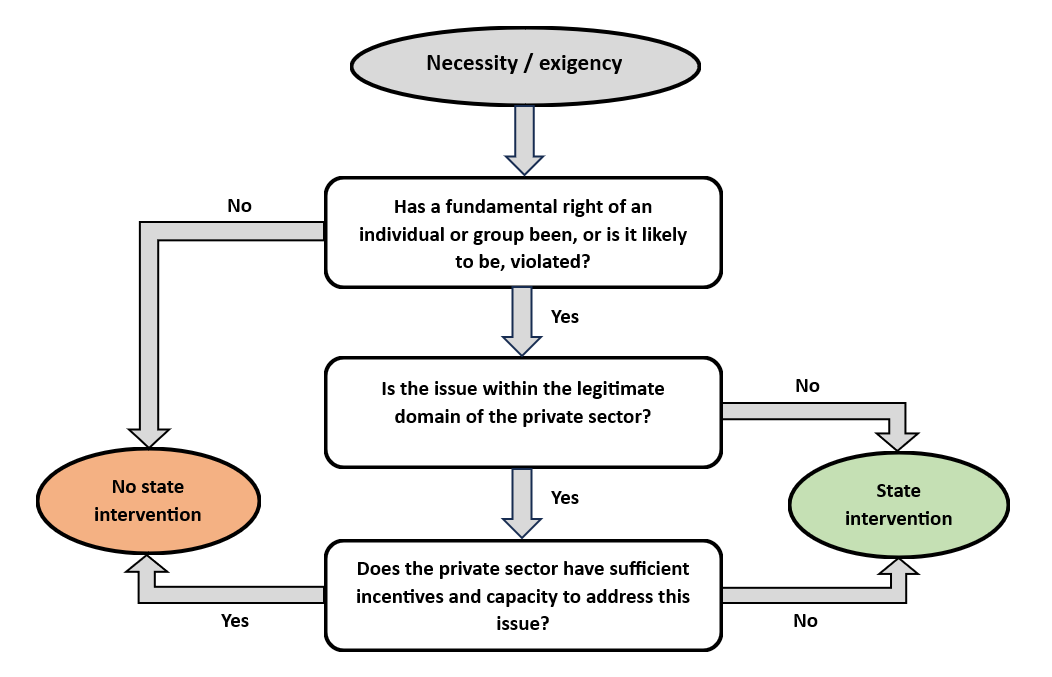
The “State Optimization Algorithm” is not designed for continuous minimization per se, but for identifying an optimal minimal threshold of state intervention. Its purpose is to prevent the emergence of an oversized, costly, and inefficient state, while simultaneously ensuring that reasonable expectations aligned with citizens’ essential needs are not left unmet.
However, several fundamental questions remain in this regard: What criteria should be used to determine the scope of fundamental rights? On what basis can certain matters be regarded as falling exclusively within the state’s competence? How can the incentives and capacity of the private sector across different domains be assessed? And finally, how can the standard level—or minimum threshold—be defined in areas that are classified as fundamental rights?
In response, any situation in which individuals or groups within society experience deprivation such that, in the absence of adequate coverage, there is a clear and widespread risk of violation of their natural rights, should be regarded as a “crisis threshold.”
However, the determination of this threshold is contingent upon the overall economic conditions of each country. In lower-income societies, these minimum standards are set closer to conditions of immediate mortality, whereas in more affluent societies the crisis threshold is defined with a greater margin of safety from such conditions.
With regard to the exclusive competence of the state in certain domains, sovereign intervention can only be justified where market mechanisms are unable to emerge, and where competition in a given sector would require coercion or entail violations of the rights of others. Only under such conditions can the state’s unique and sovereign role be recognized and its authority to intervene be legitimized.
As for assessing the incentives and capacity of the private sector, a historical understanding of each country’s developmental trajectory and existing infrastructure allows for an estimation of its capabilities through the dynamics of a free market system. In such cases, the state should limit itself to identifying gaps in provision and, without imposing constraints on private actors or distorting price mechanisms, undertake interventions solely to secure endangered fundamental rights.
Based on this algorithm, the state is granted exclusive authority to intervene only in a very limited and clearly specified set of circumstances. In all other domains, it is obliged to recognize and accommodate the role of the private sector. In this way, a robust institutional constraint against state expansion is established, while at the same time allowing for limited and defensible public intervention in specific areas.
This algorithm simultaneously ensures the identification of the optimal scope of the state and, consequently, the determination of an appropriate ceiling for its budgetary requirements. In doing so, it significantly reduces reliance on public resources such as taxation, while maximizing the space available for private-sector growth and diversified investment.
Our Partners