Why big government is hard to shrink
The size of government matters because it shapes how much room remains for private choice, enterprise and investment. From a classical liberal perspective, government provides an essential framework for markets, but expanding its responsibilities carries costs. Taxation reduces the resources people can allocate themselves and can weaken incentives to work, save and invest. Public spending must therefore be judged against the private uses of the resources it displaces. Where public expenditure exceeds half of gross domestic product (GDP), as it does in France and Germany, political decisions determine how a substantial share of national income is raised and redistributed.
Borrowing postpones the financing burden rather than eliminating it. Excessive debt commits future revenues to interest payments, creates pressure for higher taxes and leaves governments more exposed to rising financing costs. The question is whether political institutions can keep public commitments within sustainable limits, and why doing so has proved so difficult.
Three decades of government expansion
Governments in the United States, the United Kingdom, France and Germany command substantial financial resources, but their relative sizes have followed different paths. Between 1995 and 2025, the clearest expansion occurred in the UK. France maintained consistently high spending and revenue ratios, while Germany experienced significant periods of retrenchment. In the U.S., spending increased moderately relative to output, while revenue failed to keep pace. In all four countries, total revenue includes social contributions and non-tax receipts, and spending includes transfers, so these ratios do not measure the government’s direct share of production.
FACTBOX: Government spending and revenue
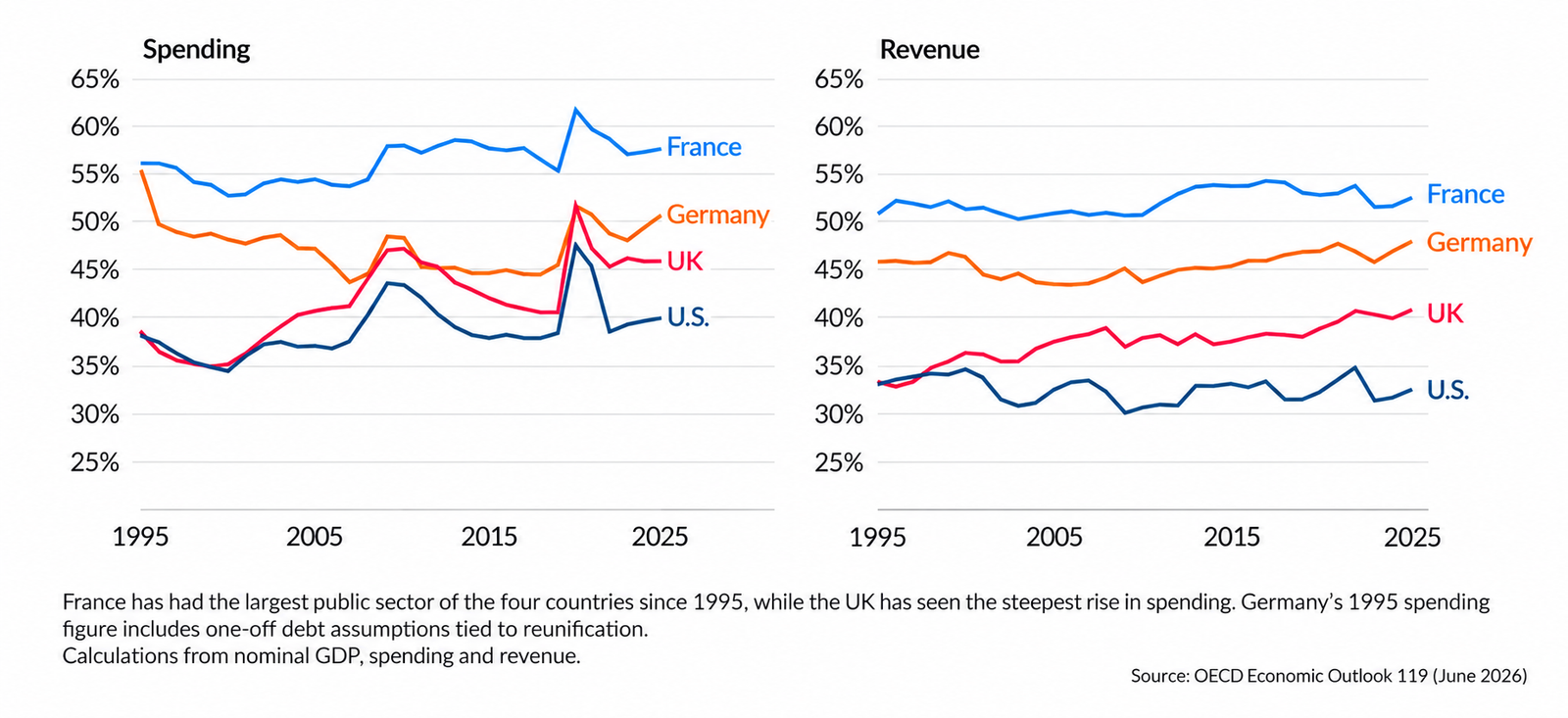
The UK government’s spending rose from 38.4 percent of GDP in 1995 to 46.1 percent in 2025. Revenue increased almost as much, from 33.4 to 40.6 percent. These changes were far from continuous: Spending declined in the late 1990s, climbed through the 2000s, shot up around the global financial crisis and subsequently fell before surging again in 2020. By 2025, it remained well above its pre-pandemic share.
France occupied the upper end of the comparison throughout this time period. Spending reached 57.4 percent of GDP in 2025, against revenue of 52.3 percent. Both ratios were approximately 1.4 percentage points above their 1995 levels. The French experience illustrates the persistence of a large state.
Germany’s spending ratio fell substantially before the global financial crisis and rose again during successive crises. Its unusually high 1995 figure includes the one-off assumption of debts left over from reunification, making the apparent decline to 50.5 percent in 2025 misleading as a measure of lasting retrenchment. Revenue rose from 45.8 to 47.8 percent of GDP.
The U.S. retained the lowest revenue ratio of the four countries. Receipts declined slightly, from 33.1 to 32.5 percent of GDP, while spending increased from 38 to 39.8 percent.
FACTBOX: Government gross financial liabilities
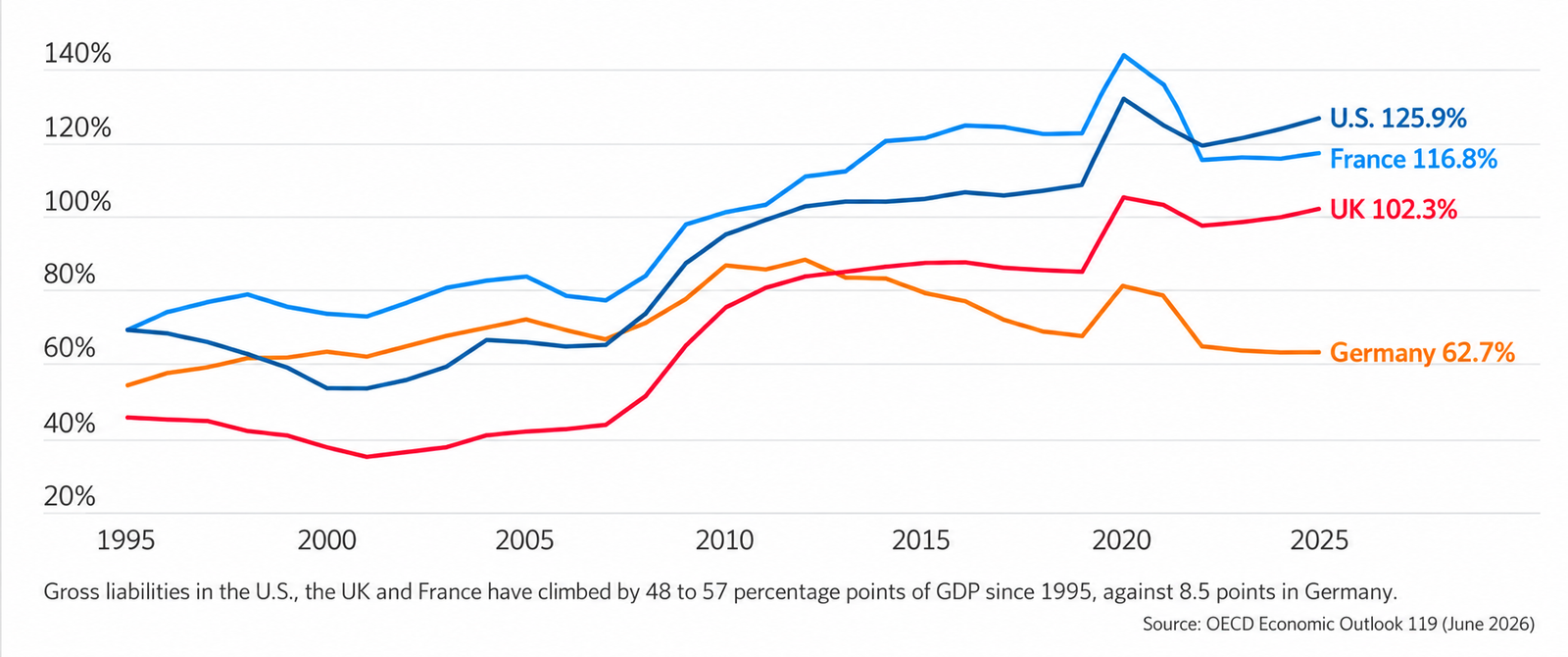
Spending has outrun revenue in most years. France ran deficits throughout the period, while the U.S. and UK balanced their books only briefly around 2000. Germany is the exception, with surpluses through much of the 2010s. Liabilities accumulated accordingly. Between 1995 and 2025, general government gross financial liabilities rose from 69.1 to 125.9 percent of GDP in the U.S., from 44.9 to 102.3 percent in the UK and from 69.0 to 116.8 percent in France. Germany’s increase was much smaller, from 54.2 to 62.7 percent, with a sustained decline following its 2012 peak interrupted by the pandemic.
These liabilities cannot be read simply as accumulated annual deficits: Asset transactions and valuation changes also matter. Nevertheless, the combined picture is revealing. Spending commitments have generally exceeded revenue, while major crises have produced sharp increases in spending and liabilities relative to GDP. Subsequent reductions have varied substantially.
Expansion is easier than retrenchment
Public choice economics offers an explanation for the persistence of large governments: Political decisions reflect the incentives facing voters, politicians and public officials. Those incentives often favor additional spending and deferred financing, even when fiscal restraint commands support in public rhetoric.
The first mechanism is the unequal distribution of benefits and costs. A subsidy can be highly valuable to its recipients while costing each taxpayer relatively little. Beneficiaries therefore have strong incentives to organize, lobby and defend the program. Individual taxpayers have less reason to spend time opposing it. Within government, spending ministries face a similar incentive: Each can press for resources for its own priorities while sharing the financing burden across the entire budget. The result can be spending commitments that collectively exceed what taxpayers would willingly finance.
Borrowing weakens the immediate political constraint. New benefits are visible, while the taxes needed to finance them can be postponed. Politicians seeking reelection may therefore prefer debt to either higher taxes or unpopular spending reductions. In “Democracy in Deficit” (1977), James Buchanan and Richard Wagner argued that democratic fiscal policy can develop a persistent bias toward deficits when spending decisions become detached from the requirement to raise matching revenue. This mechanism helps explain why liabilities can grow substantially even when expenditure does not rise continuously as a share of GDP.
Crises can reinforce this asymmetry. Emergency support introduces new beneficiaries and responsibilities, creating constituencies for continued intervention. Once households, businesses and public agencies have adjusted to support, withdrawing it imposes visible losses. Ending a program is therefore politically harder than introducing it. Fiscal reforms confront immediate, identifiable costs, while their benefits are often spread across society and emerge only gradually.
This tendency is not an iron law: The charts show substantial reductions after crisis peaks and periods of sustained restraint. Nor does every spending increase require a public choice explanation. Population aging puts pressure on pension and healthcare budgets, while voters may knowingly prefer more extensive public services. Political incentives shape how governments accommodate those demands and distribute their costs. The central difficulty is that each commitment has defenders, while responsibility for the overall financing gap is dispersed. Durable restraint therefore depends on institutions and political coalitions capable of choosing between competing commitments and sustaining those choices after the immediate pressure to reform has passed.
Scenarios
Most likely: Continued fiscal drift
Governments preserve major spending commitments while introducing selective tax increases and occasional savings. Aging populations, competing demands for public services and NATO members’ 2025 pledge to raise defense and security-related spending to 5 percent of GDP by 2035 make substantial retrenchment politically difficult. Borrowing continues to bridge the gap between promises and revenue, and persistent deficits could sustain inflationary pressures.
This would not mean continuously rising spending ratios everywhere. Economic growth and temporary restraint could produce periods of stabilization. Nevertheless, debt would remain high, with the U.S., the UK and France particularly exposed to further accumulation. Germany could retain a comparatively stronger position without being immune to these pressures. Its 2025 decision to exempt defense spending above 1 percent of GDP from the constitutional debt brake and create a 500-billion-euro infrastructure fund already points to higher borrowing. The probability of this scenario is 50 percent.
Less likely: Sustained fiscal reform narrows the financing gap
Persistent inflation could change the political calculation. If voters associate declining purchasing power with excessive government spending and borrowing, the electoral cost of fiscal expansion could rise. Inflation would not automatically produce reform: Governments might instead respond with subsidies and compensation, reinforcing spending pressures.
Durable adjustment would require a coalition willing to reform pensions and other entitlements, eliminate poorly targeted subsidies and restrain expenditure growth across several electoral cycles. Credible budget rules could reinforce those choices. Policies that improve conditions for private investment and productivity would also help, since faster growth lowers debt relative to output.
Success would be measured by a lasting narrowing of financing gaps and a declining debt ratio. Temporary spending freezes or inflation-driven increases in nominal tax receipts would provide little evidence of structural change. The probability of this scenario is 25 percent.
Less likely: A crisis shock accelerates indebtedness
Intensifying international conflicts or a severe economic crisis could push governments toward substantially greater borrowing. Higher military expenditure, emergency assistance, financial rescues and weaker tax receipts could widen deficits simultaneously. Governments entering the shock with elevated liabilities would have less room to respond.
If investors demanded higher interest rates, debt-service costs would compound the initial deterioration. Political resistance to taxes and spending cuts could then encourage further borrowing, pressure on monetary authorities or measures directing domestic savings toward government financing.
A shock could eventually force reform, but adjustment would arrive under less favorable conditions. The defining feature of this scenario would be a sustained acceleration in debt accumulation beyond the gradual deterioration envisaged under the first scenario. The probability of this scenario is also 25 percent.



Our Partners