3rd Award in Vernon Smith Prize 2025
ex aequo (1 of 2)
Why free markets do not impoverish the poor
Valeria Lucia Rios Sánchez
Abstract
The following essay analyzes one of the most controversial debates: the idea that the rich become richer at the expense of the poor. Drawing on the contributions of Ludwig von Mises, Friedrich Hayek, and Israel Kirzner, the essay refutes this notion by arguing four points:
(1) The error of the zero-sum mentality, (2) The justified profits of the entrepreneur, (3) The difference between the power of the millionaire and the coercive power of the state, and (4) The importance of private property as a barrier against tyranny.
These arguments demonstrate that, in free markets, wealth is not a zero-sum game; it expands. Likewise, the essay rejects the belief that the entrepreneurial millionaire gets rich by exploiting the poor, and points out that, in a state governed by the rule of law, defending private property means defending both rich and poor. In fact, the wealthy often act as the first line of defense against tyranny. Thus, what is needed to achieve mutual benefit between the two groups are strong institutions that uphold property rights, guarantee individual freedom, and provide the right economics incentives. Cases in which millionaires become wealthy through corruption or by the use of coercive power is not a market failure, and are not characteristic of a state governed by the rule of law; rather, it reflects institutional problems. Therefore, it can be concluded that the proposed question is misguided; it should focus on the role of the state.
At present, the mistaken idea that the poor get poorer as the rich get richer persists; however, this idea is untenable. While in the past, especially during the hierarchical order of European feudalism, the economy was indeed a zero-sum game: social classes and lifestyles were determined from birth to death, social mobility was stagnant, and the political order was profoundly oppressive, humanity left behind this paradigm.
This shift was particularly evident during the Industrial Revolution, when people became highly productive. The so-called ” marginalized ” or “proletarians,” whom the feudal government could only manage to place in workhouses or poorhouses, began to form groups to determine what to produce and how to innovate. This new industry, through mass production, created goods that could be acquired by any social class, goods that were previously exclusive to the elite (Mises, 1959).
As a consequence, today, especially in capitalist countries, there is relatively little difference between the basic living standards of the so-called upper and lower classes; both have access to food, clothing, and housing. In the US, the difference between a rich man and a poor man is often only as significant as the difference between an Audi and a Chevrolet. The Chevrolet may have been bought used, but it essentially serves the same purpose for its owner: he, too, can drive from point A to point B. Furthermore, about two-thirds of households in the US live in their own homes and apartments.
In this essay, I will argue that the idea that the poor are poorer because of the rich becoming richer is unfounded and a fallacious argument. In a context of clear property rights and free markets, the interaction between both groups is mutually beneficial; by contrast, inequalities are exacerbated by inefficient state interventions that violate free market principles. I will develop the argument in four parts:
(1) The error of the zero-sum mentality, (2) The justified profits of the entrepreneur according to Israel Kirzner, (3) The difference between the power of the millionaire and the coercive power of the State according to Hayek, and (4) The importance of private property as a barrier against tyranny.
I. The zero-sum mentality error
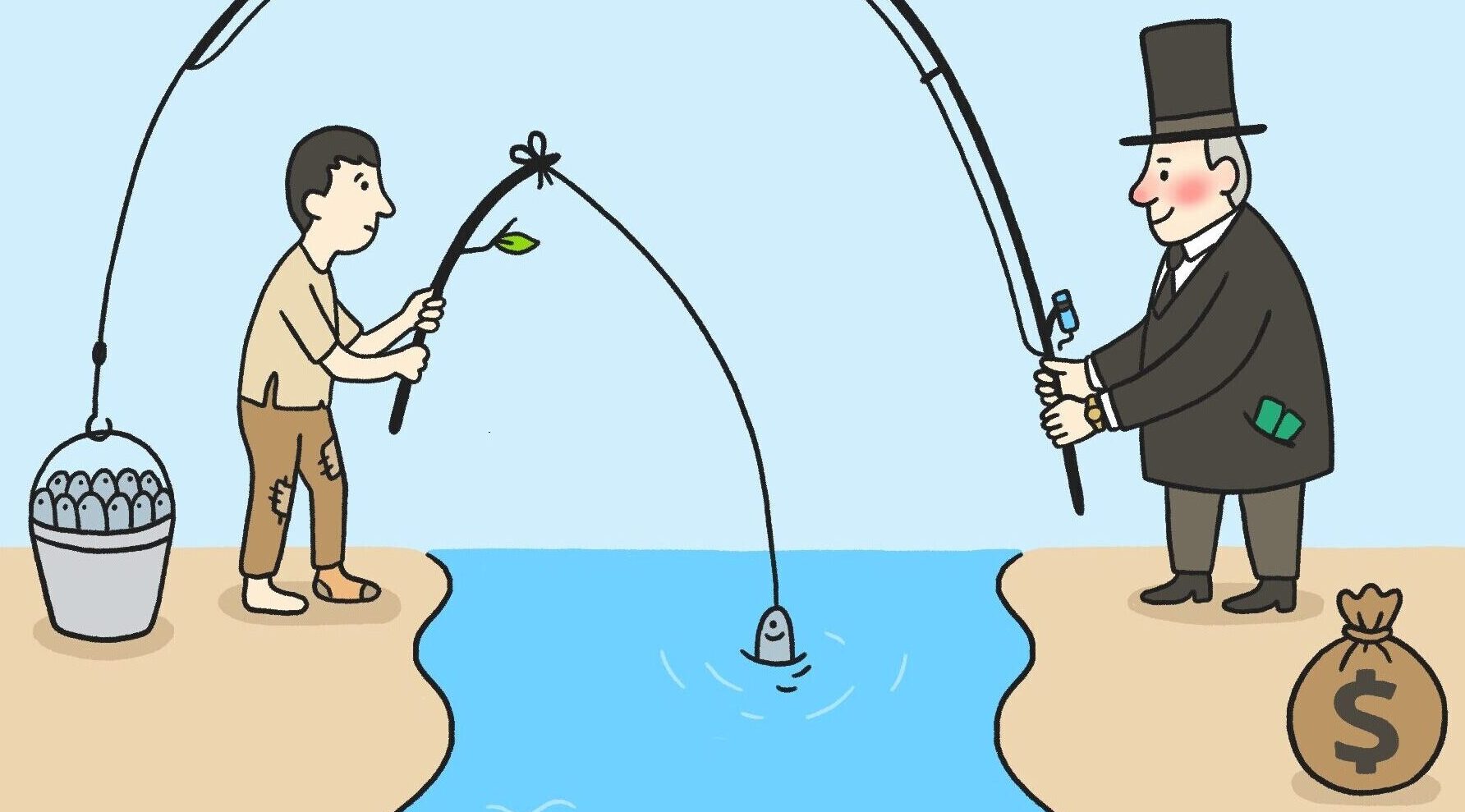
The idea that millionaires get rich at the expense of the poor is based on a zero-sum mentality, which suggests that the advancement of some requires the regression of others and that the pie is fixed in size since resources do not expand, they are only redistributed. However, in the modern economy with free markets, the interaction between rich and poor is positive-sum; the pie can indeed grow.
Proof of this can be seen in the success stories of technological innovation where, by creating innovative and revolutionary platforms, millionaires like Mark Zuckerberg (creator of Meta), Jan Koum (creator of WhatsApp), or Jeff Bezos (creator of Amazon) have democratized access to digital platforms, simplified businesses operations, connected the world through free communication, reduced the cost of thousands of imported goods, among other benefits they have generated for humanity.
An illustrative example is the creation of Facebook Marketplace in 2016, a user-friendly and accessible platform that connects buyers and sellers worldwide. Users of the platform can sell a variety of products for free, including furniture, electronics, and even cars and houses (Winn, 2019).
Therefore, Zuckerberg, Koum, and Bezos didn’t become millionaires by making others poor; they became millionaires by innovating, creating value, and making life easier for millions of people. Their results acted like an invisible hand: in seeking personal gain, they supported others as well.
Empirical data also provides clear evidence that the interaction between millionaires and the poor is not a zero-sum game. Since 1990, extreme poverty worldwide has decreased significantly, not only in absolute terms but also in relative terms. Thirty-five years ago, 43.4% of the population lived in extreme poverty, while today this figure has decreased dramatically to 10.1%, despite the global population having grown by more than 50% over the same period (Hasell et al., 2022). If the economy were a zero-sum game, as many claim, how did such a significant percentage of the world’s population cease to be poor? Why did they stop being poor? The answer is clear: It was the creation of value through voluntary exchange.
It is worth noting that what Zuckerberg, Koum, and Bezos needed to innovate and generate value for millions of people was an environment of individual freedom. Ludwig von Mises states that value creation occurs when one can decide what to study, what to invest in, what to undertake, or where to work; individual freedom allows us to have our own life project. For his part, Friedrich A. Hayek, according to his definition of spontaneous order, states that the market is a spontaneous order where thousands of individual decisions (the decision to create a technological service, for example) generate wealth and economic progress without the need for central planning; everything is an unplanned result of thousands of personal actions. In this way, wealth expands without the need of a central planner.
Consequently, wealth is not a fixed pie; the interaction between rich and poor is clearly positive-sum. While the rich increase their wealth, the poor benefit through cheaper products or faster services, allowing them to become increasingly productive and seize opportunities. The constant mobility in the world confirms this: poor people becoming rich, and even rich people losing their wealth and becoming poor. But, to achieve this benefit, the interaction must be based on the functioning of the free market and individual freedom, not on central planning that limits innovation and competition.
II. The justified profits of the entrepreneur according to Israel Kirzner
In the eyes of the public, entrepreneurs, who are often the primary source of millionaires, are the most criticized, as many claims they become richer at the expense of the poor. It is assumed they deceive consumers, exploit their workers, take advantage of circumstances, collude to create monopolies, and that their profits are undeserved. However, the role of the entrepreneur is justified because they not only discover but also fulfill a social function by seeking to share their discoveries with the wider community.
In the US, we hear about a new product or some improvement almost every week. These improvements are generated by businesses, because thousands upon thousands of entrepreneurs strive day and night to find a superior product that is cheaper to produce than existing ones. The effect of this is that the US has experienced an almost miraculous improvement in the standard of living compared to the conditions that existed a hundred years ago (Mises, 1959).
Israel Kirzner (1993) provides and ethically justification of entrepreneur’s profits, stating that they prosper by discovering opportunities: imagining, searching, bridging the mutual ignorance between seller and buyer, detecting price discrepancies, seeing what others don’t, among others. All of this while assuming risk and facing uncertainty like no other, operating in that way on a “mysterious path.” In this sense, it is ethical for an entrepreneur to become wealthy; it reflects that they have done things right and that their wealth doesn’t stem from “good luck,” but rather from being awake and alert. Thanks to them, we gain the benefits of the market economy (Libertarianism.org, 2012).
Furthermore, there is a social function behind this discovery. When an entrepreneur discovers a new product or service, their interest lies in sharing that discovery with the public. For example, when Steve Jobs created the iPhone in 2007 and launched it, consumers also discovered they liked iPhone technology, as evidenced by its evolution from the first-generation iPhone (2007) to the iPhone 17 (2025). Thanks to the entrepreneur and his contribution to society, the world as a whole discovered something new.
Similarly, Kirzner also emphasizes the importance of the entrepreneur’s role in wealth creation in a nation. He states that the entrepreneur is essential for the functioning of the market economy, even calling it the driving force of the economy. However, for a country to prosper through entrepreneurship, it needs a solid institutional environment: property rights, contractual freedom, proper incentives, as well as economic freedom (Larroulet & Couyoumdjian, 2009).
If these conditions do not exist, the consequences lead to paradoxical results, as seen in Latin America: a region with high levels of entrepreneurship (the second highest rate in the world) but relatively modest economic growth rates. In this region, entrepreneurship is driven more by necessity than opportunity, which increases the likelihood of informality and limits economic agents to take advantage of the market.
In this way, entrepreneurial profits are ethically justified because they discover, socialize this discovery, and improve consumers’ living conditions. However, to achieve economic growth through entrepreneurship, the institutional factor is crucial; a weak institutional environment will prevent the realization of its benefits.
III. The difference between the power of the millionaire and the coercive power of the state according to Hayek
“The power that a multimillionaire has over me—whether my neighbor or my boss—is far less than that of a low-ranking bureaucrat wielding the coercive power of the state, upon whose discretion my very existence may depend”
(Hayek, 1944).
The argument that millionaires use their “power” to harm the most vulnerable and enrich themselves is also unreasonable, since there is a clear difference between two types of power: economic power and coercive power. In The Road to Serfdom (1944), Friedrich A. Hayek asks: What real influence does a multimillionaire have over me? He concludes that it is not economic power that impoverishes, but rather the coercive power of the state. The economic power of the wealthy does not oppress; it is the state that can oppress.
Regarding economic power, it’s mentioned that the most a millionaire could do is convince me, since the entrepreneur is the one who serves the consumer given the thousands of options and competitors in the market. Through a voluntary agreement, the consumer is free to accept or reject the entrepreneur’s proposal; if accepted, they benefit, and if not, there are no consequences. The millionaire’s power is limited because I can say “No.”
In contrast, the power of the state (officials, mayors, inspectors, among others) has more real power over the lives of citizens than any millionaire, since it possesses coercive power that obliges compliance. The state can impose fines, prohibitions, businesses closures, or even imprisonment. Thus, while one power is persuasive, the other is forceful.
The case of Venezuela is one of the most illustrative examples for understanding how state power can impoverish the most vulnerable. Under the plan “Socialism of the 21st Century,” the Venezuelan government nationalized and expropriated thousands of companies, spent and printed money arbitrarily, causing Venezuela’s inflation to become the highest in the world, and also imposed price controls on the most basic food items, resulting in shortages, black markets, and product confiscations.
As a result, by December 2024, more than 7.89 million Venezuelans (both rich and poor) had migrated to other countries (International Organization for Migration, 2024). The pattern is clear: socialist economic interventions such as nationalizations and increased public spending lead to lower investment, reduce production, and higher prices, which, combined with price controls, result in catastrophic consequences, especially for people living in poverty (Donway, 2019).
Likewise, the negative effects of coercive power can also be seen even in a developed and democratic economy such as the United States. Under the slogan “Make America Great Again,” the tariff policies imposed by the Donald Trump administration will disproportionately affect low-income families, who tend to purchase mostly imported goods (Egan, 2025). As a result, by 2026 the number of Americans living in poverty will likely increase by 875,000, raising the rate to 10.7% (The Budget Lab at Yale, 2025). Furthermore, retail giants like Walmart and Target have announced that the cost of the tariffs will be passed on to customers (Clarke, 2025).
Now, while it is true that in practice, millionaires can use their economic influence to access a certain degree of political power, this does not correspond to a world of equal treatment under the law; what is being perpetuated is a privilege. In a state governed by the rule of law, private
wealth does not grant coercive power.
Hence, the question “Are the poor getting poorer because the rich getting richer?” is misdirected according to Hayek’s perspective. It is not the millionaire who makes the poor poorer; it is the State, whose coercive power and arbitrary decisions, affect the quality of life of its citizens. The cases of Venezuela and the United States have been illustrative examples of this point.
IV. The importance of private property as a barrier against tyranny
In many discussions, defending private property is almost synonymous with “defending the interests of the wealthy.” However, private property benefits both rich and poor. When one defends the private property of the wealthy, it is because they have a legitimate interest in defending the property of the poor. The rich act as allies of the most vulnerable in a free society against tyranny.
In a world of scarce resources, private property grants individuals the security of having complete control over an asset, developing it, planning for the future, and motivating them to work harder to acquire more goods. Property rights allow individuals to see the fruits of their effort and identify themselves as the owners of goods.
This logic breaks down under socialism, where private property is abolished. Ludwig von Mises explains that for an economy to function prosperously, prices serve as a guide that enables exchange. However, in a socialist economy, there is no private property or market prices for the means of production, which prevents economic calculation. Without prices for productive factors, the socialist state cannot economize or know the cost of production. An example of this is the Soviet Gosplan, which ended up using U.S. Sears catalogs to determine prices. As a result, by abolishing private property in socialism, production becomes inefficient, productivity is nonexistent, and scarcity is generated, harming the poorest, who cannot afford high prices or access substitutes.
Furthermore, there is also a political role in defending property rights. In The Road to Serfdom (1944), Hayek states that private property also serves as protection against tyranny: because one has private property, one has a stronghold. In a state governed by the rule of law, an individual can remain in their home, and no one can demand they vacate the property (unless force is used); their home is their last piece of freedom.
But it is clear that those who concentrate most property in the world are the millionaires. Therefore, it is no coincidence that the first thing socialist governments or governments seeking to concentrate power do is attack the property of the wealthy, since this class can defend itself against coercive power due to the mechanisms and resources they possess. For this reason, when facing an expropriatory project or a tyranny, the wealthy act (paradoxically) as the first line of defense for the property of the poor. If it is possible to expropriate someone who has millions today and we don’t defend that, it will then be even easier to expropriate the poor person who owns a house or a small business.
In sum, the rich do not impoverish the poor; on the contrary, they benefit them by providing better mechanisms to defend property rights, which serve as protection against potential abusive coercive power. However, every step that moves us away from the system of private property and the use of money, as is the case with socialism, exacerbates poverty and distances us from a rational economic system.
Conclusion
In conclusion, the question, “Are the poor getting poorer because the rich are getting richer?”, is not reasonable; rather, it should be directed toward the role of the state. Wealth is not a zero-sum game, but rather a positive-sum game where rich and poor benefit from the exchange. Likewise, entrepreneurial gains are ethically justified since they not only discover opportunities but also socialize this discovery, raising the living standards of millions of people. Moreover, defending private property does not imply defending the rich; it implies defending both groups, and rather paradoxically, it is the rich who first defend the property rights of the poor.
The real danger lies in the arbitrary use of the State ́s coercive power, on which people’s way of life depends, and which can intervene in the economy causing expropriations, less investment, rising prices, mass migrations, and profound poverty, as seen in the case of Venezuela. Thus, to achieve wealth creation through the free market, it is essential to have solid institutions that protects property rights, individual liberty, provide proper incentives, as well as economic freedom.
As Tom Palmer (2007) emphasizes, the phrase “The rich are getting richer and the poor are getting poorer” does not apply to free markets; it applies to mercantilism and political favoritism, that is, to systems in which proximity to power determines wealth, not proximity to being wealthy.
The discussion, then, should not be about “poor vs. rich,” but about how to strengthen institutions and rules of the game that allow both groups to prosper by benefiting from the gains of the free market.
Valeria Lucia Rios Sánchez is a final-year Economics student at Universidad del Pacífico with a strong academic record, ranking in the top 10% of her class. She has experience in financial analysis, budgeting, and investment modelling through internships in finance and a family office, alongside entrepreneurial activities in import-based ventures and property management. Her interests focus on economic policy, finance, and research, supported by strong quantitative skills and international academic experience.
References:
Clarke, J. (2025, November 5). What tariffs has Trump announced and why? BBC News. https://www.bbc.com/news/articles/cn93e12rypgo
Donway, W. (2019, March 3). Venezuela’s classic socialist path to poverty and dictatorship. The Atlas Society. https://www.atlassociety.org/post/venezuelas-classic-socialist-path-to-poverty-and-dictatorship
Egan, M. (2025, September 10). Los aranceles de Trump podrían empujar a casi un millónnde estadounidenses a la pobreza, según nuevo informe. CNN Español. https://www.cnn.com/espanol/2025/09/10/eeuu/aranceles-trump-millon-estadounidenses-pobreza-trax
Hasell, J., Rohenkohl, B., Arriagada, P., Ortiz-Ospina, E., & Roser, M. (2022). Poverty. Our World in Data. https://ourworldindata.org/poverty
Hayek, F. A. (1944). The road to serfdom. Routledge.
International Organization for Migration. (2024, December). About the regional Venezuela situation. https://respuestavenezolanos.iom.int/en/about-regional-venezuela-situation
Larroulet, C., & Couyoumdjian, J. P. (2009). Entrepreneurship and growth: A Latin American paradox? The Independent Review, 14(1), 81–100. https://www.jstor.org/stable/24562213
Libertarianism.org. (2012, August 12). Israel Kirzner on ethics and entrepreneurship [Video]. YouTube. https://www.youtube.com/watch? =rIvgc5hXqS4
Mises, L. von. (1979/2010). Economic policy: Thoughts for today and tomorrow (B. B. Greaves, Ed.). Liberty Fund.
Palmer, T. G. (2007). Twenty myths about markets. Students For Liberty / Jameson Books. The Budget Lab at Yale. (2025, September 9). The effect of tariffs on poverty. Yale University. https://budgetlab.yale.edu/research/effect-tariffs-poverty
Visual Journalism Team. (2019, February 4). Venezuela: All you need to know about the crisis in nine charts. BBC News. https://www.bbc.com/news/world-latin-america-46999668
Winn, L. (2019, October 15). Founder of Facebook Marketplace Deb Liu shares how Sheryl Sandberg convinced her to join. ABC News. https://abcnews.go.com/Business/founder-facebook-marketplace-deb-liu-shares-sheryl-sandberg/story?id=66268072


Our Partners