1st Award in Vernon Smith Prize 2025
Who exploits whom? Spain’s welfare state and the return of zero-sum politics
Andrés Ruiz Benito
ABSTRACT
Public debate increasingly frames inequality as a zero-sum process: “the poor get poorer because the rich get richer”. Proper economic theory rejects this inference for competitive markets, where voluntary exchange and entrepreneurship can expand output and allow gains to be mutually beneficial. This paper argues, however, that the persistence of the zero-sum intuition is not fully explained by economic illiteracy. Using Austrian class analysis, we relocate “exploitation” from market exchange to the fiscal and regulatory State, where redistribution is coercively financed and rules are politically set. Contemporary Spain serves as a case study. We construct an age-profile of taxes and social security contributions paid versus public expenditure received, showing that working-age citizens are systematic net contributors, while older citizens (~65+) are, by a wide margin, the largest net recipients. As wealth in Spain rises sharply with age —especially through housing assets—, these transfers result in the relatively poorer working-age citizens subsidizing relatively richer retirees. We then extend the analysis beyond explicit fiscal transfers to housing regulation, arguing that policy-induced scarcity raises rents and functions as an implicit transfer from younger tenants to older owners. Finally, we explain why democratic incentives in an ageing society entrench these patterns, stabilizing zero-sum extraction within an otherwise positive-sum market order.
Introduction
In recent decades —especially following the popularization of the inequality literature associated with Thomas Piketty (2014) and similar authors—, public debate has increasingly treated the claim that “the poor are getting poorer because the rich are getting richer” as the default frame for discussing economics. Yet, this conclusion assumes a zero- sum view of wealth creation, as if gains at the top must mechanically imply losses at the bottom. Proper economic theory, however, decisively rejects this premise. In a dynamic economy, voluntary exchange, entrepreneurship, and capital accumulation can expand total output, so one person’s improvement need not entail another’s impoverishment (Rothbard 2009; Mises 1998; Huerta de Soto 2010, etc). Or, in Rothbard’s characteristically blunt style: “Since every exchange demonstrates a unanimity of (ex ante) benefit for both parties concerned, we must conclude that the free market benefits all its participants” (Rothbard 1997, italics are mine).
We do accept that assessment about markets, however, we argue that, despite being a common response from free-market defendants, it offers an incomplete diagnosis of why the zero-sum intuition persists. Nonetheless, authors like Juan Vallet de Goytisolo have successfully captured the idea we want to bring forth. In his words, “the gravest accusations launched against capitalism often correspond to facts that have been possible, on an enormous scale, thanks to the collaboration of the interventionist State, i.e., the State that is no longer merely an arbiter but has assumed the role of principal actor”1 (1974, 59). Along similar lines, it is our belief that when people perceive that some are enriched at others’ expense, the perception is not necessarily mistaken. However, economic theory states that, for these cases, the relevant mechanism cannot be a competitive market, but rather, other possibilities such as State intervention.
To explore this idea, we will use contemporary Spain as a case study, and a simple but revealing metric: net public transfers by age, computed as per-capita taxes and social security contributions paid minus estimated public expenditure received. As will be shown, working-age citizens (roughly 20–64) are systematic net contributors, while older ones (~65+) are, by a wide margin, the largest net recipients. Unsurprisingly, this uneven distribution intersects with wealth structure, as older age groups in Spain are also disproportionately more asset-holding, especially via housing property.
The paper’s core conclusion is therefore an answer to the question at hand. In a free market, it is mistaken to infer that the poor get poorer because the rich get richer. However, once we shift the analysis to account for the the fiscal and regulatory State —where transfers are coercively financed and the rules of exchange are politically set— zero-sum relations can and will be created and stabilized. Spain’s intergenerational transfer structure thus offers a concrete setting in which to test that claim and to reconsider where, in modern democracies, “exploitation” can occur.
Austrian class analysis the real “Exploitation”
It is no surprise that among libertarians and free-market economists, Karl Marx is often treated as an author best left relatively unmentioned. The impulse is understandable, given how Marx’s labor theory of value and his account of capitalist “exploitation” did not withstand the marginalist critique (Böhm-Bawerk 1949). Yet it is a mistake to infer from this that Marx “got everything wrong,” or that the social intuition he popularized —namely, that modern societies can generate systematic patterns of one group living at the expense of another— must therefore be an illusion. In fact, Hans-Hermann Hoppe (1990) already provided a useful way to salvage the valid parts of that intuition while discarding the erroneous mechanism. In Hoppe’s reconstruction, exploitation is not primarily a relation between capitalists and proletarians, but a relation between those who control the coercive apparatus of the State (and the interest groups alligned with them) and those who are compelled to finance it. The crucial implication for present purposes is straightforward. Once redistribution is institutionalized through political means, zero-sum relationships are no longer a rhetorical exaggeration, but an expected outcome of the system (Hoppe 2001; Brennan and Buchanan 1980).
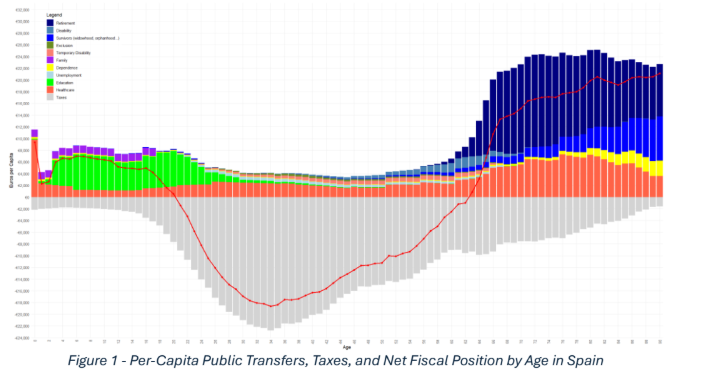
This framework motivated the empirical exercise that follows. Inspired by the online work of François Valentin and Jon González, we have constructed an age-profile representation of Spanish taxes and public transfers, summarized in Figure 12. The figure reports per-capita euros by single year of age. Stacked bars above zero measure estimated public expenditure received at each age, while gray bars below zero measure estimated taxes and social security contributions paid. The red line traces the net benefit —that is, total public transfers considered minus taxes paid at each point. It is advised to consider the resulting series as a rough estimate assembled from available aggregates and age-distribution proxies. Nevertheless, the pattern is sufficiently stark so that the qualitative conclusions are likely to stay relevant even if we managed to improve the data available.3
Three broad facts stand out. First, ages 0–20 are net recipients, as expected, given that education, health and family transfers dominate while taxes paid are close to zero (aside from indirect taxes such as VAT). Second, the working-age population —roughly 20 to 66— is systematically a net contributor, with the largest negative Net Benefit concentrated during the early 30s. Third, from roughly 65 onward, individuals become net recipients again, and by a wide margin. Therefore, the elderly are the largest net beneficiaries in per-capita terms. The mechanisms behind this pattern are, however, not mysterious. This is exactly what one should expect from the combination of a universal, tax-financed healthcare system with strongly age-concentrated costs, and a pay-as-you-go pension structure, where current workers finance current retirees. Consequently, while the particular magnitudes and age cutoffs are specific to Spain, the broad shape of the curve can be interpreted as a generic feature of European welfare states built around similar pension and healthcare systems.
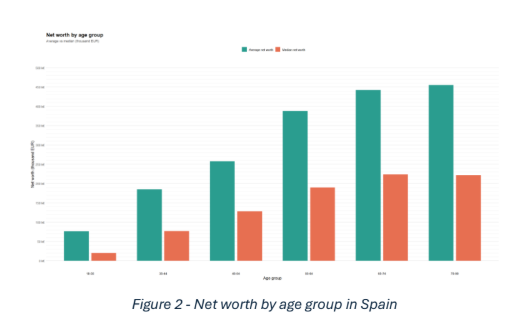
Now, the real elephant in the room: what severity of this specific “exploitation” lies not in the mere existence of intergenerational transfers, but in their redistributive incidence when combined with the existing structure of wealth in Spain. As Figure 24 clearly shows, net wealth in Spain rises sharply with age, both in average and in median terms. Thus, older citizens are not merely major recipients of public transfers, they are also the wealthiest segment of the population. The implication is uncomfortable but difficult to avoid. The relatively poorer working-age citizen systematically subsidizes relatively richer retirees. The asymmetry is particularly harsh for those under 35, whose median net wealth is roughly a quarter of the immediately next age bracket —the other 35 to 44 years old “youngsters” —; while, as shown before, they keep the most negative Net Benefit. In other words, the fiscal architecture channels resources away from the ages at which individuals are typically forming households, building initial savings and attempting upward mobility, toward those that, on average, already hold the bulk of accumulated assets.
Taken together, these results provide the first concrete application of Austrian class analysis to the Spanish case. The relevant “classes” are not defined by occupation or sector, but by their systematic fiscal position. Once we incorporate the fact that net recipients (the elderly) are also, on average, the richest segment of the population, the fiscal structure can no longer be described as a simple mechanism of solidarity or lifetime insurance. Rather, it becomes an institutionalized pattern of extraction in which a relatively poorer, working-age class, is compelled to finance the consumption and wealth-preserving benefits of a relatively richer retired class. This, precisely, is the sense in which “exploitation” can reappear; not via market exchanges, but through the tax-transfer State.
Housing regulation as an intergenerational transfer
The fiscal age-profile described in the previous section captures only explicit transfers financed through taxes and social security contributions. While this is the most visible channel of intergenerational redistribution, it is by no means the only one. For example, Spain also exhibits antoher mechanism through which resources are reallocated from younger, relatively poorer citizens to older, relatively richer ones: housing. The basic ownership pattern is well known and empirically robust. Older citizens are disproportionately homeowners, whereas younger ones —especially under 35— are disproportionately tenants, entering the housing market later and with less accumulated wealth (Torres 2023). In other words, Spain’s housing stock is predominantly held by those closer to retirement age, while the marginal demand for rental housing is disproportionately
generated by those at the beginning of their working lives.
This, by itself, would not necessarily be a problem. However, Spain’s housing market is by no means an example of a relatively free market. The supply of new housing and the ability of existing stock to adjust to changing demand is shaped by layers and layers of state intervention. Zoning and land-use restrictions, urban planning requirements, bureaucratic constraints and costs, as well as slow permitting processes, alter the profitability and risk profile of supplying new housing. The particularities of each intervention are relatively irrelevant for the case at hand. What matters is that, by restricting entry and delaying adjustment, these interventions will necessarily tend to increase the price of housing over the one that would have otherwise been5 (Hülsmann 2003). As rental stock cannot therefore expand or reallocate fast enough to match demand, this would, in turn, create a tendency to increase house rental prices over those we would otherwise find.
Once the ownership pattern is acknowledged, the distributional implication follows in a relatively straightforward manner. The rent burden falls mainly on younger citizenss because they are more likely to rent (Torres 2023). Conversely, rental income accrues primarily to owners, who are disproportionately older. When regulation increases rents by constraining supply, it does more than just “raising the cost of living” for the young. It alters the flow of resources between identifiable groups: tenants pay more per month for the same accommodation, and owners receive more per month for the same asset. This can be reinterpreted again as an implicit, de facto transfer from younger to older citizens. Calling this transfer “non-market” may sound paradoxical, since rent is paid through market contracts. However, even when rent payments occur through formally voluntary exchanges, the conditions under which these contracts are signed —namely, the scarcity of alternatives created by policy constraints— mean that the observed price is not the output of undistorted competitive markets. The transfer is therefore not the result of superior entrepreneurial foresight or productive contribution by the recipient group, it is the result of scarcity engineered by political elites. In a freer market, entrepreneurial entry and construction would tend to expand housing supply, putting downward pressure on rents and eroding excess returns. Under regulatory scarcity, however, this is not a possibility.
This interpretation reinforces the same broad pattern evidenced in the previous section. In both cases, we observe net flows from younger, poorer, citizens, to older, richer ones. The mechanisms differ, but the direction of redistribution is aligned. Furthermore, these transfers do not merely reduce current living standards for the younger generations, they also impair saving and delay entry into ownership, reinforcing long-run disparities in net worth.
Democracy and intergenerational extraction
If these were isolated distortions, one might think that public debate could conceivably correct them via reform. Yet Spain’s political economy makes such corrections systematically difficult. The reason is that the mechanisms described above are embedded in a democratic system with an aging population. In such societies, net receivers —i.e., retirees— constitute a large and relatively cohesive voting bloc. Their cohesion stems not from a shared ideology, but from shared material interests6.
This creates a predictable incentive structure for politicians. Parties seeking office are rewarded for proposing policies that deliver concentrated benefits to large, politically reliable groups, and punished for proposing reforms that impose visible costs on them, even if those reforms could yield long-term gains for the whole. In Spain, promises to protect or expand pensions and healthcare spending, have an electoral logic. Similarly, housing policy often ends up privileging existing owners.
The result perfectly aligns with the prediction of Austrian class analysis. Net tax consumers and beneficiaries of regulatory privilege have a structural incentive to defend the institutions that sustain their position. Net contributors, on the other hand, bear the costs. In an aging democracy, the demographic weight of beneficiaries grows, and with it, dies the political feasibility of counter-reforming.
This helps explain why deep reforms, such as moving from a pay-as-you-go pension scheme to a more market-oriented capitalization system, faces such severe constraints in practice. A political party credibly committed to such reform would need to confront a large set of voters whose expected benefits would be threatened. The rational strategy for vote-maximizing politicians is therefore to avoid the reform altogether or to propose minimal adjustments that preserve the system’s distributive core. By contrast, parties that position themselves as defenders of the existing PAYG structure can reliably harvest support from net beneficiaries, reinforcing a feedback loop in which interventionist platforms are systematically voted. Over time, this tendency deepens state intervention, reduces the scope for market adjustment, and undermines the productive capacity of the economy by raising burdens on the working-age population.
The danger is thus not only economic but institutional. Once a large enough voting bloc becomes dependent on state transfers and regulation, the democratic process will become a mechanism for stabilizing said privileges. Therefore, democracy in an aging welfare state does not merely permit intergenerational redistribution, it institutionalizes it. The combination of explicit and implicit transfers, reinforced by electoral incentives, functions as a mechanism that stabilizes and deepens these zero-sum relationships.
Conclusion
The question at hand, that is, whether the poor are getting poorer because the rich are getting richer, invites an immediate and, in many contexts, correct rejection of zero-sum thinking. In dynamic market economies, wealth is not a fixed pie. Yet, the persistence of the zero-sum intuition in everyday political discourse is itself a phenomenon that deserves explanation. If “enrichment at another’s expense” were purely a fallacy, it would be hard to account for the plausibility that many citizens continue to attribute to it —especially in societies where large segments of the population feel increasingly trapped by high taxes, high rents, and stagnant prospects.
This paper has argued that this widespread intuition is not necessarily wrong in its descriptive core. Rather, it is frequently wrong in its institutional attribution. The common story argued by the intellectual left identifies capitalism and market exchange as the engine of exploitation. By contrast, Austrian class analysis relocates the exploitative relation to the sphere of coercion. Once redistribution is institutionalized through political means, zero-sum relations are not merely possible; they become an expected outcome of the system.
In the realm of voluntary exchange, it is indeed mistaken to infer that the poor must get poorer because the rich get richer. However, once analysis shifts to the fiscal and regulatory State, where transfers are coercively financed and the rules of exchange are politically set—zero-sum relations can be created, expanded, and maintained. It is therefore unsurprising that many citizens intuitively perceive “enrichment at another’s expense”. Unfortunately, their moral outrage is then redirected toward “capitalism” rather than toward the political system that produced these transfers.
This is where the tragedy lies. So long as the intellectual left is the only camp willing to offer a narrative about how and why such extractions occur, the average citizen, who lacks the analytical tools to note otherwise, will accept that narrative and treat the market order itself as the culprit. Meanwhile, free-market advocates often worsen the situation by speaking as if exploitation were impossible in principle, simply because it cannot arise in a truly free market. But our societies are not ideal types; they are mixed systems, with markets embedded in dense frameworks of taxation, regulation, and privilege. In such a world, defending the market only in abstract terms can become strategically and scientifically insufficient. The consequent scientific obligation is to identify, with as much clarity as possible, the specific channels by which intervention generates systematic transfers. The relevant question is not whether exploitation can exist, but where it is institutionally located. Only then can public discourse move beyond emotionally compelling but analytically mistaken accusations against “capitalism,” and toward a more accurate
diagnosis of how modern democracies can generate zero-sum extraction within otherwise positive-sum market orders.
Andrés Ruiz Benito is an Account Manager with a background in economics and experience in client relations, financial reporting, and property management operations. He holds a BSc in Economics and is completing an MSc in Economics with a strong academic record and research focus on the Austrian School. He combines analytical skills, technical proficiency, and international experience.
1 “Las más graves acusaciones que se lanzan contra el capitalismo corresponden a hechos que han sido posibles, en su enorme dimensión, por la colaboración del Estado intervencionista, es decir, del Estado que no se ha contentado con ser sólo arbitro y ha asumido, a la vez, el papel de actor principal”
2 Source: Author’s elaboration, based on multiple sources. Healthcare, education, and the taxes aggregate are anchored to the latest available Eurostat totals and allocated across ages using the most recent National Transfer Accounts (NTA) age profiles. Contributory pensions (retirement, disability, survivors) and unemployment benefits use administrative totals and age-group information from Seguridad Social and SEPE, with single-year age profiles obtained by smoothing age-group data via PCHIP. Exclusion is extrapolated from Ingreso Mínimo Vital recipient profiles by age. Temporary disability is estimated combining IVIE evidence on age incidence and mean salaries with total temporary-disability expenditure from Seguridad Social. Family spending is allocated using total expenditure from the COFOG classification report and the underage population distribution. Finally, Dependence uses data from the Instituto de Mayores y Servicios Sociales (IMSERSO).
3 For Spain, closely related age-profile exercises appear in to reach similar conclusions (Solé et al. 2020).
4 Source: Author’s elaboration, based on data from the Encuesta Financiera de las Familias (EFF) published by Banco de España
5 For complementary evidence from mainstream economics on land-use controls and affordability, see Glaeser and Gyourko (2002).
6 Additionally, political participation itself is not age-neutral, as older citizens tend to vote at higher rates, strengthening the electoral weight of net beneficiary groups (Goerres 2007).


Our Partners